
Collected Problems for Test 2
Problem Set #5
#1. A 30.0 g arrow is shot by William Tell through an 8.00 cm thick apple sitting on top of his son's head. The arrow enters the apple at 30.0 m/s and emerges at 25.0 m/s in the same direction.
a) Sketch a free body diagram of the arrow when passing through the apple.
b) What is the acceleration of the arrow?
c) With what force has the apple resisted the arrow?
#2. Two boxes are connected by a light rope are on a frictionless surface. A force F is applied to m2 causing the masses to accelerate at 2.43 m/s2 to the right. The mass of m1is 4.11 kg and the mass of m2 is 6.21 kg.
a) Draw a free body diagram of each block.
b) What is the tension T in the connecting rope?
c) What is F?
#3. The diagram below shows a mass m1 = 2.1 kg and a mass m2 = 4.1 kg suspended from lightweight cables. It is found that theta 1 is equal to 20o when the center rope is adjusted to be closely horizontal. Determine the tension and the angle of rope 3.

Problem Set #6
#1. A winch is used to drag a 375 N crate up a ramp at a constant speed of 75 cm/s by means of a rope that pulls parallel to the surface of the ramp. The rope slopes upward at 33o above the horizontal, and the coefficient of kinetic friction between the ramp and the crate is 0.25.
a) Draw a free body diagram.
b) What is the tension in the rope.
c) If the rope were suddenly to snap, what would be the acceleration of the crate immediately after the rope broke? Draw a new free body diagram.
#2. Objects of masses m1=4.00 kg and m2 = 9.00 kg are connected by a light string that passes over a frictionless pulley. The object m1 is held at rest on the floor, and m2 rest on a fixed incline of 40.0o relative to the horizontal. The objects are released from rest, and m2 slides 1.00 m down the incline in 4.00s.
a) Determine the acceleration of the object.
b) Find the tension in the string.
c) What is the coefficient of kinetic friction between m2 and the incline?

#3. A large mass of 110 kg is swung in a horizontal circle while attached to two cables as shown in the diagram. The mass rotates at a rate of 31 rpm (revolutions per minute). Find the tension in each cable.

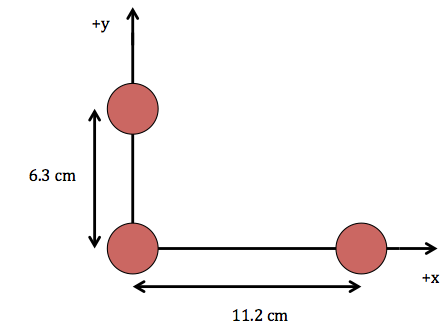
#4. Consider the diagram below. What is the net gravitational force, magnitude and direction, on the mass at the origin? Assume all masses are 220 kg.
Problem Set #7
#1. Tarzan swings on a 30.0 m long vine initially inclined at an angle of 37.0o with the vertical.
a) Sketch a diagram and indicate your reference level.
b) What is his speed at the bottom of the swing?
c) If he pushes off with a speed of 4.00 m/s what is his speed at the bottom of the swing?
#2. A toy car of mass .073 kg is compressed against a spring shown below. The spring is compressed 9.1 cm and has a spring constant of 9.83 N/m. When the car is released it moves across a frictionless table and then goes off the 22o ramp. Determine how far from the edge of the table the car lands if the ramp is 1.22 m above the floor. Neglect any height change due to the ramp.

Problem Set #8
#1. An 8.00 kg package in a mail-sorting room slides 2.00 m down a chute that is inclined at 53.0o below the horizontal. The coefficient of kinetic friction between the package and the chute's surface is 0.40. Calculate the work done on the package by
a) friction
b) gravity, and
c) the normal force.
d) What is the net work done on the package?
#2. A box of mass 3.98 kg rests on a frictionless, horizontal surface. A student then applies a horizontal force F to it. As a result, the block moves along the x-axis such that its position as a function of time is given by x(t) = At2 + Bt3, where A = 0.200 m/s2 and B = 0.0200 m/s3.
a) Calculate the velocity of the box when t = 4.00s.
b) Calculate the magnitude of F when t = 4.00s.
c) Calculate the work done by the force F during the first 4.00s.
#3. An object is being pulled toward the origin. The force pulling on the object is Fx = -k/x2 (Gravitational and electrical forces have this distance dependence).
a) Calculate the work done by Fx when the object moves in the x-direction from x1 to x2.
b) If x2 > x1, is the work done by Fxpositive or negative?