ECE 2212
EXPERIMENT 5
11 and 18 October 2012
ADDITIONAL DIODE CIRCUITS AND APPLICATIONS
This is
a two week experiment. Work to be done 11
and 18 October with
a report due Thursday, 25 October. The
report is to be double length, that is a
maximum of 6 pages plus a cover page, which includes an
abstract, in the usual format. The report will be evaluated on a 40-point
scale, rather than a 20-point
scale.
PURPOSE
Experimentally
study the following circuits
Ø Double-diode
clipper; both time domain and transfer characteristics
Ø Voltage doubler; both time domain and transfer characteristics
Ø AND Gate; both
time domain and transfer characteristics
Ø OR Gate; both
time domain and transfer characteristics
Ø Precision
Rectifier, time domain and transfer characteristics
Ø Obtain Cj(VR) for the 1N4001 by
constructing an adjustable corner frequency analog passive low-pass filter and
compare to the data sheet. This is the
only circuit that requires some computations.
BACKGROUND
In
addition to rectification related to power supply applications as demonstrated
in Experiment 4, diode circuits are used to obtain a variety of important signal processing functions. Among them is the
clipper, precision rectifier, voltage multiplier, and diode logic. You will have an opportunity to demonstrate
these applications both experimentally and using SPICE simulations.
Ø For example,
inherent in many ICs is the use of diodes to limit input voltage transients to
levels that do not damage the IC. We
will observe this diode protection function when we study MOS and CMOS IC technology in a
couple of weeks.
Ø Voltage multipliers,
in this case a voltage doubler (although practically
not quite a factor of 2), is a cost-effective approach to obtain multiple dc
output voltages from a single voltage source (battery), especially under
relatively low current drains. You will
examine the operation by measuring both transfer characteristics and time
domain relationships
and verify your measurements using SPICE simulations. Observe that you will be using filter
networks where the time constant t = RC must be
>> (1/120) second to be effective.
Ø Diode logic is a
good way to illustrate Boolean functions using simple hardware realizations and
useful for power switching applications.
Refer to your 5 and 8 October class notes on the AND and
OR gates implemented with diodes. To a
degree, diode logic is part of more complex digital IC families.
Ø Precision
rectification is used in DSP (Digital Signal Processing) applications where the
“switch” and absolute value function needs to be implemented but there must be
a minimization of the effect of the diode forward voltage. Can we design a circuit that negates the 0.7
volt forward voltage drop? Of course the answer is yes or why would we spend
the time in the lab!
Ø We will also
study “electronic tuning” of a circuit.
We will also measure
Cj(VR) for the 1N4001 by
constructing an adjustable corner frequency analog passive low-pass
filter. The Cj(VR)
is useful for electronic tuning of communications systems. Refer to the 1N4001 data sheet distributed on
the class WEB page as
well as the specialty devices on the Motorola data sheets, also distributed on the class WEB page. Also review the passive LPF circuits we
discussed in class and measured in lab the first two weeks of the semester.
COMPONENTS
Ø 1N4001 silicon
diodes
Ø mA741 operational amplifiers
Ø A selection of
resistors between 1 kW and 100 kW
Ø A selection of electrolytic capacitors and
non-polar mylar
capacitors.
PROCEDURE
Ø Construct the
circuit shown in Figure 1. This circuit
is called a Double-Diode Clipper.
Initially, set vs(t) = 7 sin (2p x 100t). Slowly adjust the amplitude of vs(t)
and observe and record the effect on vo(t)
for various positive and negative values of V1 and V2. Also look at the transfer characteristics
and compare your results to the handout distributed in class. A triangular wave with a 7
volt peak amplitude will also work.
Ø Construct the
circuit shown in Figure 2. This circuit
consists of a diode clamp followed by a peak rectifier. Again, initially set vs(t) = 7 sin (2p x 100t). Plot vo(t) and vs(t). What is the peak-to-peak ripple voltage on vo(t)? Why is this circuit
sometimes called a voltage doubler? Examine what happens as you change the load resistor ranging from 100 kW down to 1 kW.
Ø Construct the
circuits shown in Figures 3 and 4, an AND gate and OR gate respectively. Set various combinations of VA and VB
voltage levels to verify the appropriate logic gate operation. Use a square wave on one of the inputs
recognizing that you will need to DC off set the square wave voltage such that
the minimum voltage is 0. Suggest R on
the order of 5 kW.
Define the voltage ranges for the LOGIC ZERO and ONE logic
levels.
Ø Measure the
transfer characteristic of the circuit shown in Figure 5a. Pay particular attention to the effect of the
diode offset voltage. Now construct the
circuit shown in Figure 5b. Use ±12 volts for the mA 741 operational amplifier. Measure the transfer characteristic and
compare to the results in Figure 5b.
Justify the term “precision rectification” when applied to the circuit
in Figure 5b. Refer to Section 12.8 of
the text, page 760.
Ø This portion of
the experiment will allow you to measure
Cj(VR) for the 1N4001 by constructing
an adjustable corner frequency analog passive low-pass filter . These measured results will then be compared
to the data curves distributed on the class WEB page and a SPICE
simulation. Construct the circuit shown
Figure 6a. You will need to determine
the effective value of R2 and CFixed. The
best approach for determining R2, which is the input resistance of the oscilloscope is by using a DC voltage divider with R1. It
will either be 1 Megohm or 10 Megohms. Observe that the signal generator allows you
to include a DC offset. The best
approach to determine CFixed which includes the effective capacitance of
your leads, the oscilloscope, and the terminal strip with your wiring is by
measuring the -3 dB corner frequency and back calculating to obtain a value for
CFixed.
Basically, sweep the frequency of Vs with VDC = 0 to obtain the basic
low-pass filter dB amplitude plot. Now
connect the two 1N4001 diodes in the circuit as shown in Figure 6b. Starting with VDC=0, measure the resultant -3
dB corner frequency and back calculate to obtain Cj for the 1N4001. Recognize that you must subtract the CFixed and there are two diodes in
parallel. We assume both diodes are
identical and the reason two diodes are used is to improve accuracy within the
ranges of our instruments. Continue with
several other values of VDC so that you have several values of Cj to compare with the 1N4001 data curves and to
generate a CJO for a SPICE simulation.
You will also
compare against the SPICE 1N4002 library model. Also note that a data sheet for CJ for the
1N4XXX diode family was distributed on the class WEB page. To minimize the value of CFixed , be neat with your wiring dress. Also note that the scope cables will add about 30 pF/foot.
Check this using the capacitance meter.
For
all the circuits, compare your experimental results with SPICE simulations and
support your discussions from circuit analysis.
Use the .TRAN SPICE analysis for the first five circuits and the .AC
analysis for Circuit 6.
TO THINK ABOUT AND INCORPORATE IN YOUR
REPORT
Ø Did the circuits
operate as expected? Justify
analytically and using SPICE.
Ø How did the diode
offset voltage effect the results?
Ø What is the
effect of changing the RC product?
Ø Suggest system
applications for all the circuits.

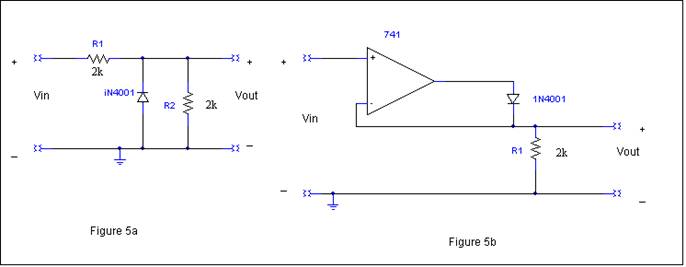

Figure 6a Baseline Circuit
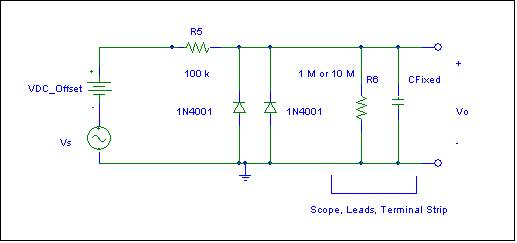
Figure 6b Diode Capacitance Measurement Circuit
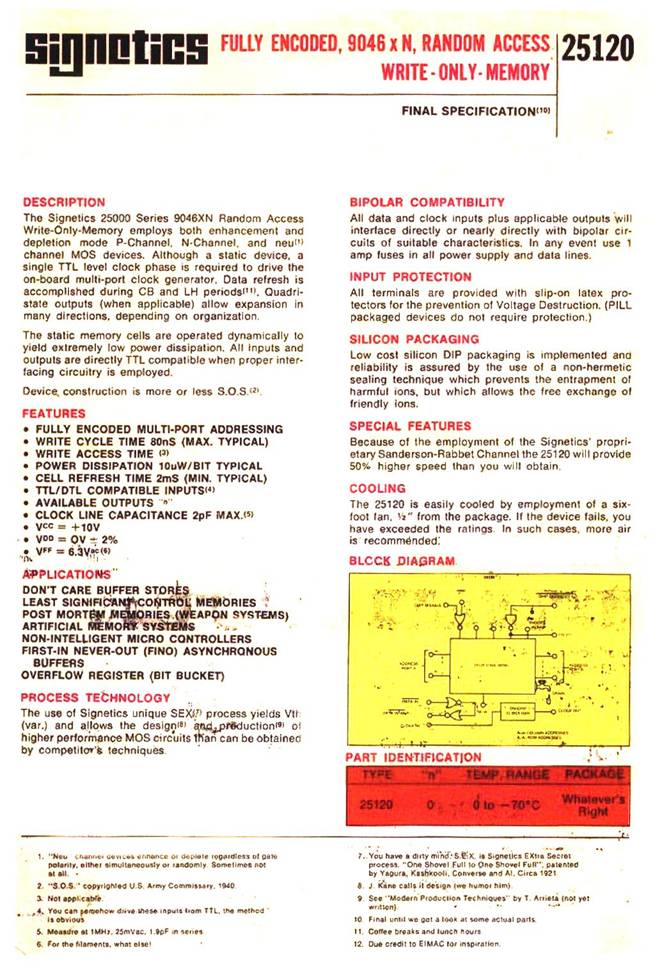
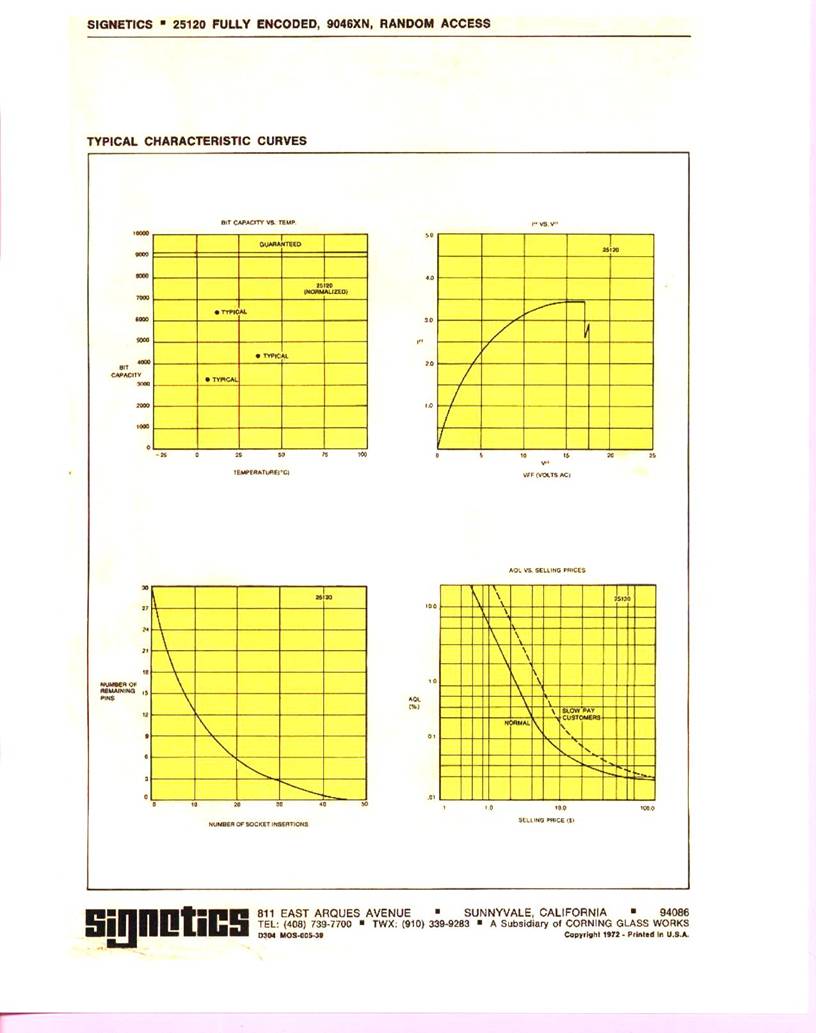
This a classic data sheet for a Write
Only Memory produced by a Signetics Engineer with
too much time
on his hands. It actually slipped by the Signetics QC
managers and was published in a data book before the “joke” was
discovered. It has become a classic in
the semiconductor industry. Read it carefully and enjoy!