ECE
2212
EXPERIMENT
6
11
April 2013
Bipolar
Junction Transistor (BJT) Measurements, Circuit Analysis, And
Amplifier Operation
COMPONENTS
2N3904 or 2N2222 npn transistor
Resistors: 5kW and 100kW
Note: Use the 2N3904 or 2N2222 npn transistor device models in SPICE rather than the
default model
DC Bias Analysis
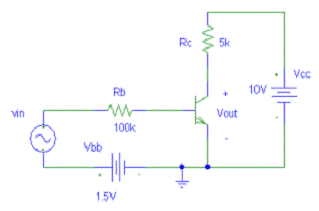
Construct the circuit in Figure 1. Use = 10
Volts for the DC supply.
Ø Measure
and record the Q-Point values of IB, IC, VBE,
and VCE. One measurement approach
to measure current is to measure the
voltage across the RB and RC resistors and using Ohm’s Law to obtain the
current rather than inserting an ammeter in series. Be sure you measure the actual resistor
values for your measurement to obtain more accurate results.
Ø Compare
your results with a SPICE analysis of this circuit. Use the 2N3904
or 2N2222 in the SPICE library. The
signal source vin(t) should be set to zero for this portion of the
experiment. You may have to adjust VGG
= 1.5 volts to obtain a Q-Point in the forward-active region because of the
potentially wide variation of BJT β values.
Ø Draw
a dc load line for this circuit. Observe
what happens to the Q-Point values as you adjust VGG to obtain
Q-points in the cutoff and saturation regions.
Demonstrate
Small-Signal and Large-Signal Operation
Ø Adjust
VGG so that your Q-point is in the forward-active region; suggest
the center third of the dc load-line.
Ø Now
set vin(t) for a 1 kHz sine
wave from the function generator. Adjust the amplitude initially to 0.5 Volts
(1 VPeak-to-Peak). Minimize any clipping on the output waveform.
Measure the voltage gain. Also show the transfer characteristic.
Ø Simulate
the circuit in SPICE with your transistor using a transient analysis. Explain your results in the context of a
load-line analysis. Use a small-signal
model to compute the voltage gain.
Ø Adjust vin(t)
to demonstrate clipping both experimentally and in SPICE.
Reminds me of the new
IEEE T-shirt design as well as the iconic Apple Commercial during the 1984 Superbowl. It is on You Tube.

Guidance for some of the
robotics projects.
Our UMD version of “what are faculty doing” is called the FIR, Faculty Information Record.