EE
2212
PROBLEM
SET 1
S.
G. Burns
Due:
30 January 2013
Ø Unless otherwise announced, I will collect the problem set when I
collect the associated quiz. It is also important to note that I often use
homework problems as part of the weekly quizzes. In collaboration with Sukriti Subedi
(GTA-Graduate Teaching Assistant), some
or all of the problems on each problem set will be graded. Quiz coverage will include material related
to, and supporting, the problem set as well as material covered in class through
the previous class period, usually through Monday’s material. Any additions or
deletions from quiz topical coverage will be announced in class, via e-mail,
and/or on the class
WEB page. I strongly
encourage you to ask questions
about the homework problems during class and during office visits. I also encourage you to
ask for assistance on any underlying and supporting topics from other courses.
You may work together, and I encourage you to do so, but remember you, and you alone, are responsible for your work and you must turn in homework individually unless
otherwise noted. Material from laboratories may also be included.
Ø ALL QUIZZES are open book and
notes. Laptops and tablets are OK but no
WEB access. Be sure and bring your
completed problem set to class.
Ø Unless otherwise noted, I use the two-person team quiz active
learning pedagogy format. Please
identify your quiz partner in advance.
It makes sense to also have that same person as your laboratory partner
although that might not work out if you
are in different laboratory sections.
You may also elect to take quizzes individually if that better suits
your learning style. Please let me know
in advance so that I prepare an adequate number of copies.
Ø QUIZ 1, nominally 20 minutes long, will be given on Wednesday, 30
January, during the last portion of the class period.
Ø Also, take the opportunity to study the text "Examples",
which includes solutions.
Ø I also encourage that you read the Preface to provide a broad
perspective on what topics are included in the text.
Ø Observe that that there are student resources available on the
publisher’s WEB site. Also be aware that
you may often use different approximations and approaches to the problem which
may result in somewhat different (but very correct) answers. Apply your skills in engineering to evaluate
the correctness of your answer and solution method should there be a perceived
discrepancy.
Ø You will need SPICE/PSPICE.
You may already have a copy from ECE 2006. An evaluation version of SPICE (PSPICE) is available from http://www.engr.uky.edu/~cathey/pspice061301.html
or from ORCAD http://www.cadence.com/products/orcad/pages/downloads.aspx
. Be sure you have a decent broadband
connection for a personal download.
PSPICE is also available on EE computers including those in MWAH 102 and
MWAH 391.
Ø One other issue which you should be aware of. I use SYMBOL
font in MSWORD, and ADOBE fonts, as needed, in preparing WEB documents. I also use IE as my WEB browser. One reason I use MS WORD and IE is that they
are available through ITSS. There are
cases where your personal WEB browser and word processing program may not
interpret SYMBOL font correctly. This is
especially true for “shareware” and non-standard versions of word processing
programs and versions
of some operating systems such as Firefox.
For example the Omega symbol for ohms which should print out as the
Greek symbol W
could print out as a W. This would occur
if your printer driver and/or word processing and/or font utility within your
WEB browser were not set up to accept SYMBOL, or in some cases ADOBE
fonts. To the best of my knowledge, all
the EE computers using IE and MS products and printers are OK but your personal
system may not be. Please let me know if
you have this difficulty so I can try and work on fixes with you.
First several problems in review of circuit analysis techniques
from EE 2006. If any of the basic circuit concepts from EE 2006 are a bit rusty (i.e., Ohm’s Law, linear
superposition, Phasors, Kirchoff’s
Laws, handling of independent and dependent sources, loop and nodal analysis,
etc. ), please ask questions either in class or stop in my
office.
1.
Text 1.21 Some plug-and-chug
practice with Ohm’s Law with an input independent voltage source.
2.
Text 1.23 Some plug-and-chug
practice with Ohm’s Law with an input independent current source.
3.
Write peak and rms phasor notation
(cosine reference) expressions for the
following signals. Sketch the resulting phasor on the complex plane at t=0.
(a) V1(t) =
100 cos (1000 t + 30°)
(b)
V2(t) = 100 cos
(1000 t) + 50 cos (1000 t + 60°)
(c)
V3(t) = 100 cos
(1000 t) + 100 cos (500 t + 60°) Be careful!
Explain why this is a trick question.
Write the time domain
function, assuming 60 Hz operation for the following rms
phasors.
(d) Va = 250 Ð30°
(e) Vb = 250
4.
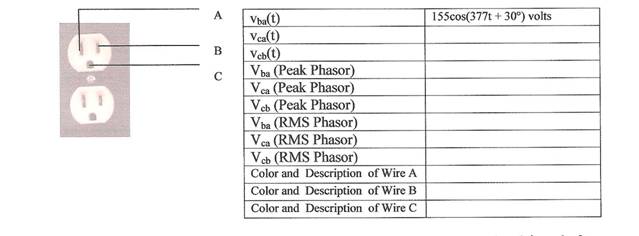
Fill in the the table for a correctly wired duplex outlet (U.S.
National Electric Code standards) where vba(t)
= 155 cos(377t + 30 ) volts
5.
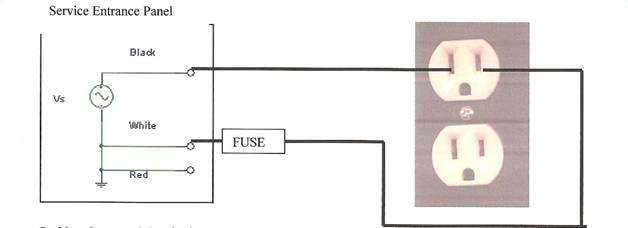
An electrical engineering student friend
from an unnamed large university in the Twin Cities did you a favor and wired up a
standard duplex outlet for you. Unfortunately he did NOT follow the National Electric Code.
(U.S. standards) Your “friend”(?) made four errors, three of which potentially could kill you!
(a)
Describe the four errors and explain how you must fix them. You can mark up the diagram appropriately or
provide a separate series
of diagrams.
(b) Identify
the three potentially
fatal errors and explain why they could lead to your electrocution.
(c) Your
friend, who will probably get an F in his circuits class, decides to demonstrate his work by
plugging in a
lamp. Will the lamp work? (YES, NO, PARTIAL
INTENSITY, EXPLODE) Circle your choice
and explain
your
answer.
6. Text
Problems 1.25 and 1.26
for Circuit (b) only). These two
problems include independent voltage and
current sources , and dependent current generators. Before
you substitute to obtain numerical values, derive an expression for the Thevanin equivalent
circuits at the
indicated nodes.