ECE
2212
PROBLEM
SET 2
(Problem
4 Figure Updated)
S.
G. Burns
Due:
5 February 2014
Wednesday
1.
A bit more
review from EE 2006.
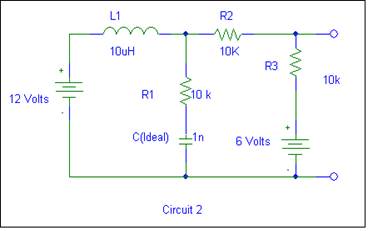
Obtain a value for the Thevanin
voltage (VTH)
and Thevanin resistance (RTH)
for the following circuit. Note that only dc independent sources are being
used. Assume an ideal capacitor and
inductor. Sketch and label the resultant Thevanin and Norton equivalent circuits.

So far we have worked
with independent sources. The next two
problems address dependent sources. These two problems include independent voltage and
current sources , and dependent current generators. Before
you substitute to obtain numerical values, derive an expression for the Thevanin
equivalent circuits at the
indicated nodes.
2. Text Problem 1.25
3. Text Problem 1.26.
We will start discussing
operational amplifiers on Monday and build on the operational amplifier topics
you covered in EE 2006. Unless otherwise
stated, assume all operational amplifiers are ideal. Therefore you can use the
summing point constraints.
4.
Text 1.37 Straightforward summing amplifier “plug and chug”.
5.
Figures P12.3, P12.9, 12.14, and P12.17 (pages 774 and
775) are cascaded operational amplifier circuits. Compute the voltage gain,  = vO/vI for
each circuit. When you use summing point
constraints and the circuit topologies we have discussed in class, the voltage
gain computation for each circuit can be done in ONE line!
= vO/vI for
each circuit. When you use summing point
constraints and the circuit topologies we have discussed in class, the voltage
gain computation for each circuit can be done in ONE line!
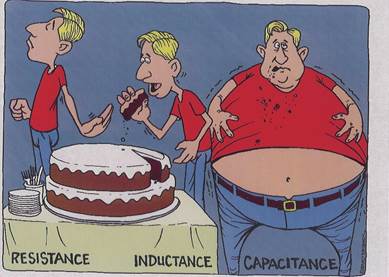
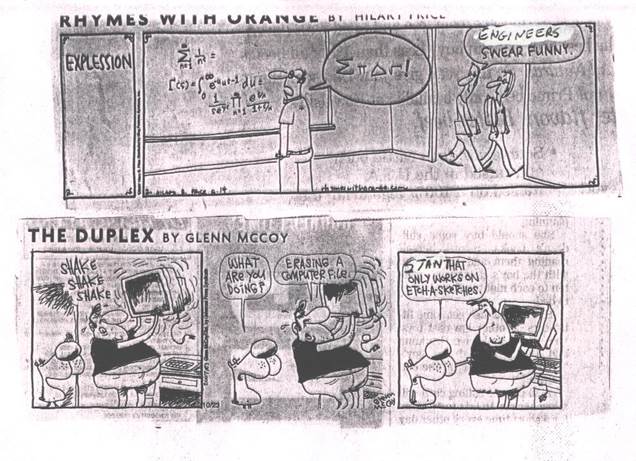
 These cartoons obtained
from a friend raiding a secret stash at a well known laboratory instrument
company.
These cartoons obtained
from a friend raiding a secret stash at a well known laboratory instrument
company.

And more from my files of good stuff:
General wisdom of the
ages because if I am not a fan of the continual requests to update something or
other in Windows