ECE 2212

PROBLEM SET 5

S. G. Burns

Due:  Wednesday, 5 March 2014

Note 1:      I am adjusting the schedule and topical coverage because of the snow day on Friday, 21 February.  This Problem Set 5 will be due on Wednesday, 5 March.  Quiz 5 will also be administered on 5 March.   There will not be a quiz or problem set due this week (24-28 February.


Note 2:  Several of the problems are include designs.  I strongly encourage that you start this problem set  in a timely manner!


1.     Text 3.72 Part (a) assumes you assume the diode switches from OFF to ON when the diode voltage is zero volts. Part (b) of problem assumes you use the diode model that just includes a 0.7 volt battery when the diode switches from OFF to ON. The best approach is to draw out each circuit and then look for any potential contradictions with the diode model and circuit when you assume a diode is either ON or OFF. Sketching a piece-wise linear I-V characteristic is one approach to piece-wise linear problems. Prepare a table to summarize your results.

2.     Text 3.21  This is very similar to the parameter extraction you addressed  in Experiment 3, 20 February.

3.     Based on an old quiz problem.  You are to design a battery charger for safe operation in a damp garage environment  to use for charging your  12 VDC car battery.
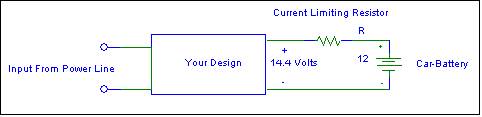
        Design, that is provide a detailed and well-labeled circuit diagram,  a dc power supply to accomplish this objective

        by satisfying the following design goals:

(a)             Input is a 110rms  VAC. (VP=110x ) at 60 Hz from a three wire service that meets the National Electrical Code.

(b)             Output is a nominal 14.4 VDC

(c)              Specify a resistor, R,  to limit the maximum battery charging current to 10 amperes.

(d)             Use a half-wave  rectifier.

(e)              There is no ripple voltage design specification.  Explain why this is unnecessary in this application.

(f)               Use a transformer .

(g)             The battery charger case is metal.

(h)             Assume a diode with VF = 0.7 V

(i)                Use a correctly located fuse in the primary circuit to protect the power supply from a short-circuit at the battery terminals either from total battery failure or accidentally short circuiting the charging cable to ground. (For example, dropping a wrench across the battery terminals-oops!).

(j)               A voltage regulator is not required


Your Design must include:


Well-labeled circuit diagram including the identification of  the incoming  “hot”, “neutral”, and “ground wires (U.S. standards) including the National Electric Code color coding of these wires and also show the correct color-coded wiring for a standard grounded duplex receptacle and plug.


                                              i.                        Key design equations and supporting calculations

                                            ii.                        Component specifications including:

                                         iii.                        Transformer-turns ratio

                                         iv.                        Diode-current and power ratings

                                            v.                        Your assessment and short discussion as to whether the laboratory 1N4001 diodes would work or not.

                                         vi.                        Value for R

                                       vii.                        Current rating of a fuse to protect the power supply against a short circuit condition at the battery terminal.


4.     Similar to an old quiz problem.  Your design team is  to design a +40 volt dc  power supply for your home sound system.  Your sound system requires  a 400 watt capability.     The power supply is energized from a three-wire 110 Vrms  60 Hz power line that meets the National Electric Code (NEC).  The system  block diagram and design specifications  are given below. 
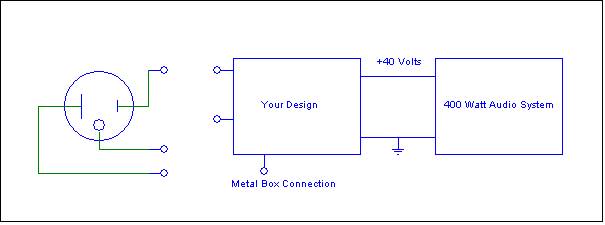


·        Input is a 110 Vrms  60 Hz.

·        Output voltage is 40 volts, unregulated.

·        Maximum allowable ripple is 2%

·        Use a full-wave bridge rectifier.

·        Use a transformer

·        Assume diodes with VF = 0.7  volts


Your design should include:

Ø Well-labeled circuit diagram of what goes in the “Your Design” box.  There should be enough detail such that someone could build an operational  prototype.  Polarities of key components are important

Ø Key design equations and supporting calculations.  Show your work!

Ø Component specifications including:

(a) Transformer-turns ratio

(b) Effective value of the audio system load resistor (speaker impedance)  and load current for a 400 watt, 40 volt system.

(c)  Capacitor value  to satisfy the2%  ripple voltage specification.

(d) Bridge rectifier diode-current and power ratings.

(e)  Correctly located primary circuit fuse and its rating.

(f)   Correct (NEC specified safe wiring) to the three wire  power line receptacle.


      5. Your smart phone requires 9.0 VDC regulated with a receive current of 5 mA and a transmit current of 200 mA. You want to use your car’s power port which has a nominal and lowest output voltage of 12 VDC although the voltage could go as high as 14.4 VDC when the engine and alternator are running. Design an avalanche diode (Zener diode) voltage regulator that will allow you to operate your smart phone from the power port. Use the discussion and circuit diagram discussed in class for guidance. (Of course you wouldn’t use your smart phone while you were driving!)

Your design should include:

(a)                   A well-labeled schematic diagram

(b)                   Key design equations

(c)                    Values including power ratings for any resistor(s) needed.

(d)                   Avalanche diode specifications that would work including VZ, IZ(min), IZ(max) and PZ.


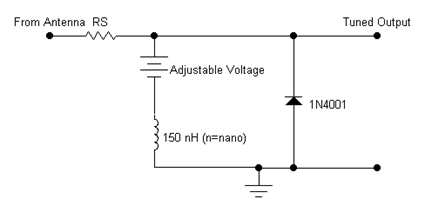
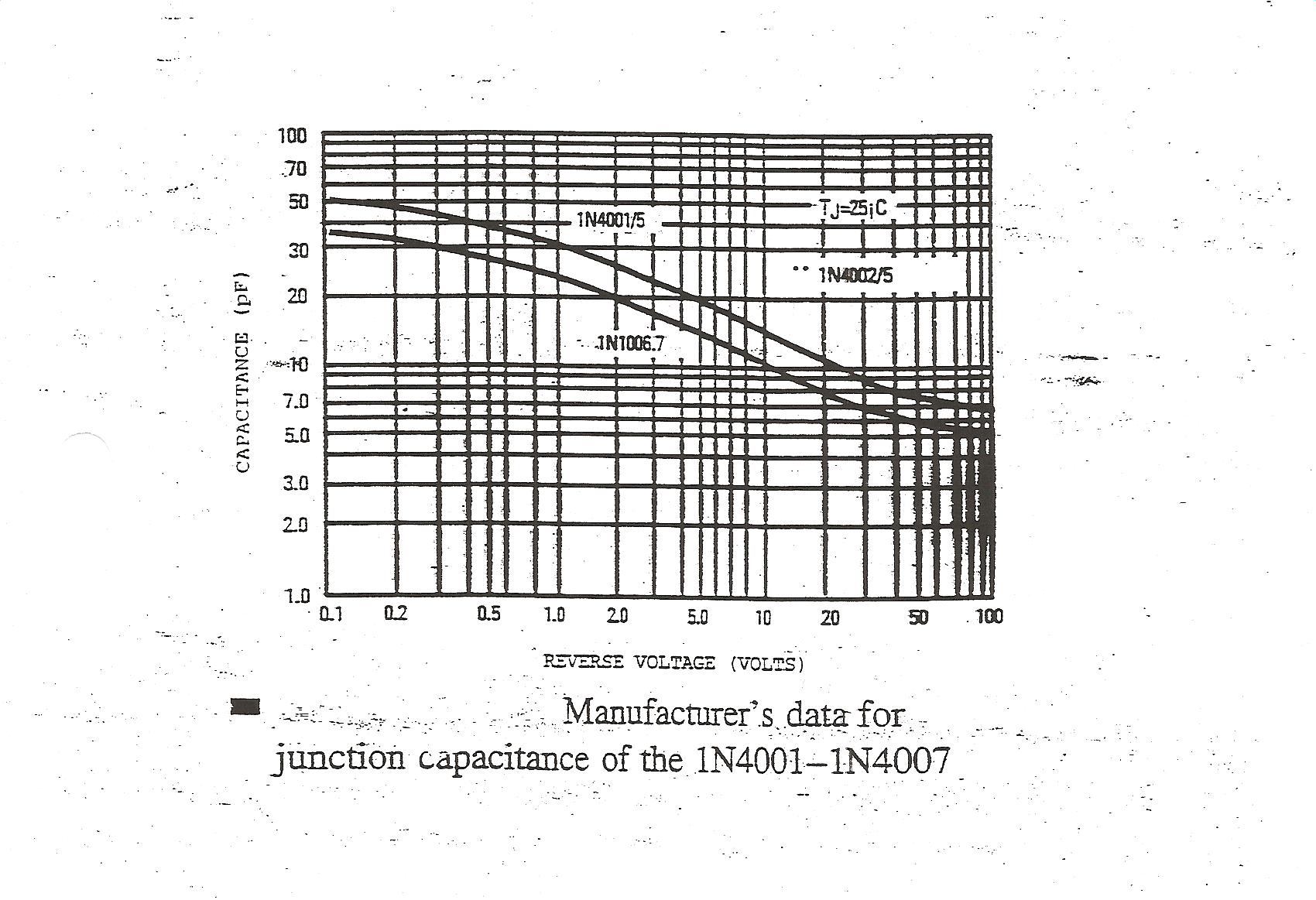
6.    Refer to the capacitance curves for the Motorola 1N4001  1N400XCap.JPG.    The input  tuning circuit of a standard analog  FM radio is given below.   Specify, that is design for, a voltage, capacitance, and inductance required  to tune the circuit to the center frequency of KUMD-FM which operates at 103.3 MHz.    Sketching and labeling a representative resonance curve would be useful to support your calculations.  There is no single correct design answer set of values since it depends upon the voltage you initially select.


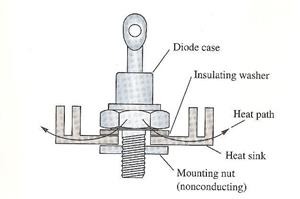
7.       A 10 volt avalanche diode has a thermal resistance of θJC = 4°C/watt. The maximum junction temperature is 175°C operating at an ambient temperature of TA=40°C.  A heat sink with 6°C/watt of thermal resistance from the sink to ambient is used but must be electrically isolated from the diode case with a thin mica washer having a thermal resistance of 2°C/watt.  See the figure.  What is the maximum value of IZ and illustrate using a sketch of the derating curve. 

DiodeThermalDiagram


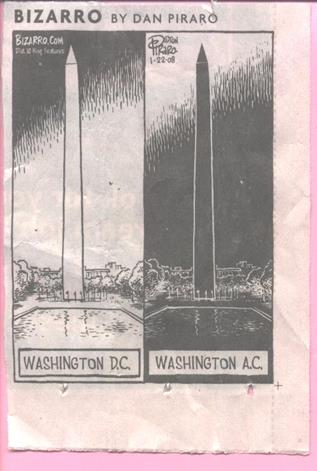
Since we are talking about converting AC to DC:

ProblemSet5cartoon

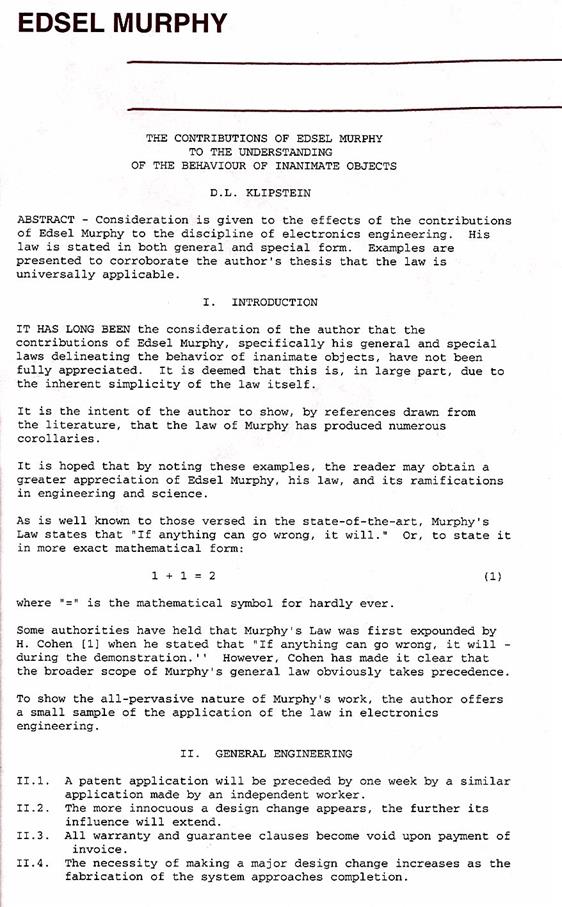
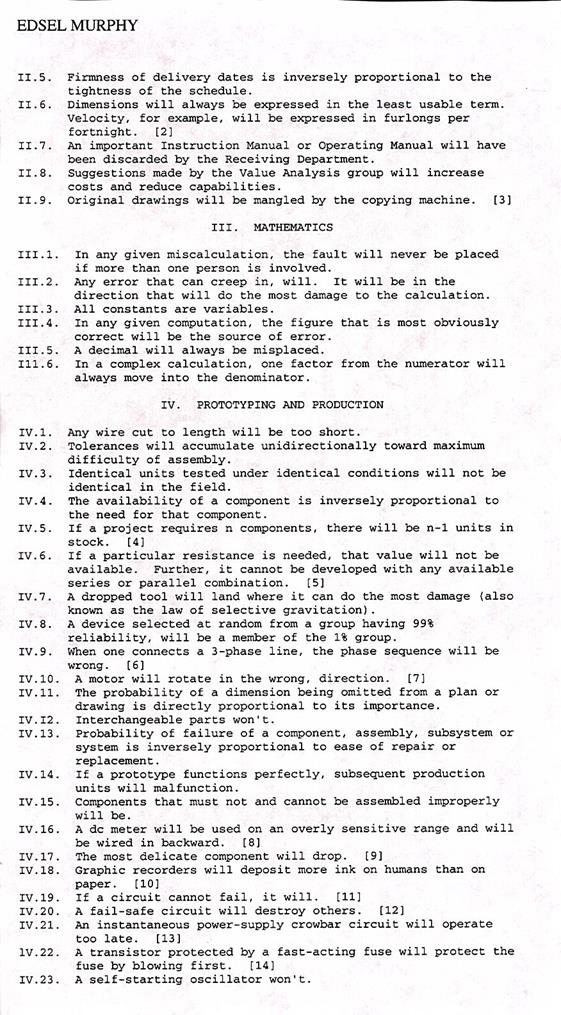
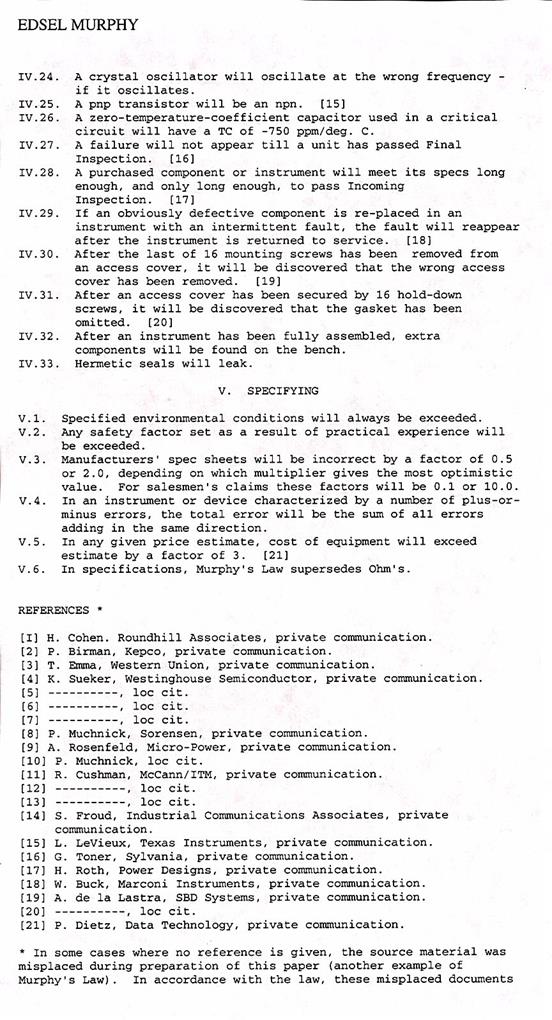
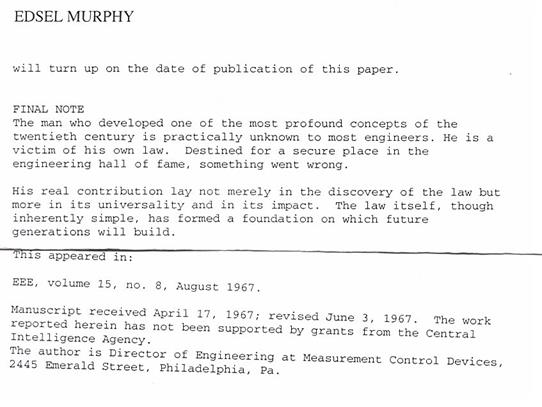
All of you are now far enough along in your engineering studies to fully appreciate a full-blown version of Murphy’s Laws excerpted from the original paper.

murphy1

murphy2

murphy3

murphy4.jpg

I have been emphasizing  units and unit conversion throughout the semester.  Here are some additional conversion factors you should be aware of.  They are best reviewed over a beverage of your choice.


SPECIAL UNITS AND CONVERSION FACTORS

Ratio of an igloo's circumference to its diameter: Eskimo Pi

2000 pounds of Chinese soup: Won Ton

1 millionth of a mouthwash: 1 microScope

Time between slipping on a banana peel and smacking the pavement: 1 bananosecond

Weight an evangelist carries with God: 1 billigram

Time it takes to sail 220 yards a 1 nautical mile per hour: Knot-furlong

365.25 days of drinking a low-calorie beverage: 1 lite-year

16.5 feet in the Twilight Zone: 1 Rod Serling

Half of a large intestine: 1 semicolon

1,000,000 aches: 1 Megahurts

Basic unit of laryngitis: 1 hoarsepower

Shortest distance between two jokes: A straight line

454 graham crackers: 1 pound cake

1 millionth of a phone: 1 microphone

1 million phones: 1 megaphone

1 million bicycles: 2 megacycles

2000 mockingbirds: two kilomockingbirds(This is a bit subtle from a literature class)

10 cards: 1 decacards

1 kilogram of falling figs: 1 Fig Newton

1000 grams of wet socks: 1 literhosen

1 millionth of a fish: 1 microfiche

1 trillion pins: 1 terrapin

10 rations: 1 decoration

100 rations: 1 C-ration

2 monograms: 1 diagram

8 nickels: 2 paradigms

2.4 statute miles of intravenous surgical tubing at Yale University Hospital: 1 IV League

100 senators: Not 1 decision