EE 2212
EXPERIMENT 4
16 February 2017
Report Due: Thursday, 23 February
Diode ID-VD
Measurements and the Half Wave Rectifier
PURPOSE
Ø Use laboratory measurements to extract key
diode model parameters including IS, n (also called η or N in
SPICE) from the ID-VD measurements of the 1N4001. All specifications except the (Peak Reverse
Voltage or the Peak Inverse Voltage) PRV (PIV) should be virtually identical
between the 1N4001 (PRV=50 volts) and 1N4002 (PRV=100 volts). PRV or PIV is the Peak Reverse Voltage; Peak
Inverse Voltage as provided by the manufacturer. Thou shall not exceed the PRV(which
would be tough to do in the EE 2212 lab)!
Ø Implement designs of the half wave
rectifier circuit and measure time domain characteristics and the transfer
characteristic.
Ø Measure and compute ripple voltage as a
percentage and as an rms value. You can use both the soft-keys on the
oscilloscope or the multimeter.
Ø Compare individual diode results and
circuit results using SPICE simulations.
COMPONENTS
Ø 1N4001 Diodes (Use the 1N4002 diode model
in SPICE)
Ø 100 and 1 kΩ
resistors
Ø 0.1 μF,
1μF, and 10μF capacitors Actual values not critical since you
are just showing the “filtering/smoothing” effect to minimize ripple voltage.
PROCEDURE
ID-VD
Characteristics and Diode Model Parameter Extraction
Ø
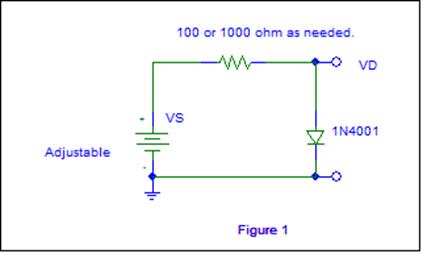
Using SPICE, simulate the circuit shown in Figure 1.
Obtain the ID-VD characteristic curve for the
1N4002 in SPICE over
a range at least of 0 to 0.8 volts for VD and find the diode current value for the diode when VD = 0.7 volts. For this, it might be useful to use a DC
voltage sweep in conjunction with a VDC source. In addition, you will need to
change the x-axis value to be the voltage across the diode (v+) – (v-) under Plot_Axis Settings…_Axis Variable…-
Ø
Examine the model characteristics for the
1N4002 PSPICE, which can be
found
by selecting the device and then Edit_Model…_Edit
Instance Model (Text)… You will use this information
forcomparing to your measurements.
Ø
Construct
the Figure 1 circuit. Use the multimeter to measure ID and the multimeter also to measure VD. Note the ID is measured by measuring the voltage
across the resistor and dividing by R, that is apply Ohm’s Law. Pay attention to the diode orientation. The
banded side is the cathode end. Change the
supply voltage VS to adjust ID to the desired current
setting, then measure VD. Take enough readings to accurately define
the diode characteristic. You should
measure out to ID
values of a few mA. Record
your results in a data table in both your laboratory notebook and in your
laboratory report. EXCEL calculations
and the graphing function really works well.
Ø
I discourage the use of the multimeter for measuring current directly because very
often the internal fuse in the mutimeter is “blown”,
that is open-circuited, given the high usage factor in EE 2006
and it is a stinker to replace! I will
explain what not to do!!! Use Ohms law to obtain current by measuring the
voltage across the series resistor. The
power supply ammeter is not as accurate for this current measurement.
Ø
Consider the equation  which approximates to
 when the diode is
forward biased. To facilitate graphing
over a number of orders of magnitude we obtain and graph,
when the diode is
forward biased. To facilitate graphing
over a number of orders of magnitude we obtain and graph,
 Note that log(base
10) e = 0.434
Note that log(base
10) e = 0.434
Ø
From
this equation, determine and fit a straight line (linear regression) to your
plotted ID-VD semi-log graph. Your equation will be in
the form y = mx
+ b. I suggest referring to Problem Set
4.
Use
these data to find Is and n. Compare to the SPICE model parameters. Virtually all calculators have the linear
regression (least squares linear fit) built-in.
Be sure you know the procedure.
It will make your life easier.
Alternatively, you can create an EXCEL spread sheet and use the spread
sheet algorithm for the curve fit. The
graphing function in EXCEL also works well!
Half-Wave Rectifier
Ø
Refer
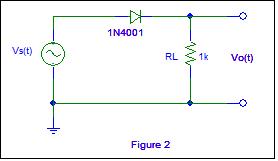
to Figure 2. Change to the signal
source to a 10
volt peak-to-peak 100 Hz sinusoid. Perform a SPICE transient analysis simulation
and observe the half-wave
rectified output. Also note the effect of
the diode offset voltage when you compare the input and output waveforms. Observe and plot Vout(t) and the transfer
characteristic, Vo vs Vinput.
Ø
Experimentally
observe the operation on the oscilloscope in both the time domain and as a
transfer function.
Ø
Now
we want to “smooth out” the pulsating DC by using capacitors. Place a
C across the 1 kΩ resistor. Now use all three values of C to illustrate
the change in the
ripple voltage by measuring
Vout(t). Use the ”Measure”
menu on the oscilloscope to measure the
rms voltage of the output using dc and ac
coupling. Explain the differences in these measurements
and explain what these measurements are illustrating. Use your diode model and check your lab
measurements using SPICE. Observe that
ripple voltage is defined as either the (DV/Vpeak) x 100%
or as
Ø
(Vrms or as Vrms of the output-voltage/Vpeak)x
100% )x 100%. Watch your polarity on the
electrolytic capacitors or else ![MM900336554[1]](Experiment4DiodesAndRectifiers_files/image010.gif) Also, since electrolytic capacitors have a broad tolerance, their values
must be checked on the capacitance meter
to obtain accurate results.
Also, since electrolytic capacitors have a broad tolerance, their values
must be checked on the capacitance meter
to obtain accurate results.
(An added historical note: The background screen is a photo of a “cat
whisker” diode used as an AM radio detector in the 1905-1920 era of early radio
before the widespread use of vacuum tubes.
A sharp springy wire (cat whisker) formed a pressure (point contact)
junction with a galena crystal. Galena
is PbS (lead sulfide) and
has a bandgap of about 0.4 eV. Of
course, the underlying physics was unknown at the time. Primitive, but it did work-sort of. A reincarnation of this was used by soldiers
in World War II in what is called a “foxhole radio”. The junction for detection of strong AM radio
signals was a sharp wire contacting a “blue edge” razor blade to form a
crude junction. The metallurgical “bluing” process to harden
the steel cutting edge on the single edge razor blade of the time creates a
difference in the work functions between
the wire and the metal razor which results in a rectifying junction.
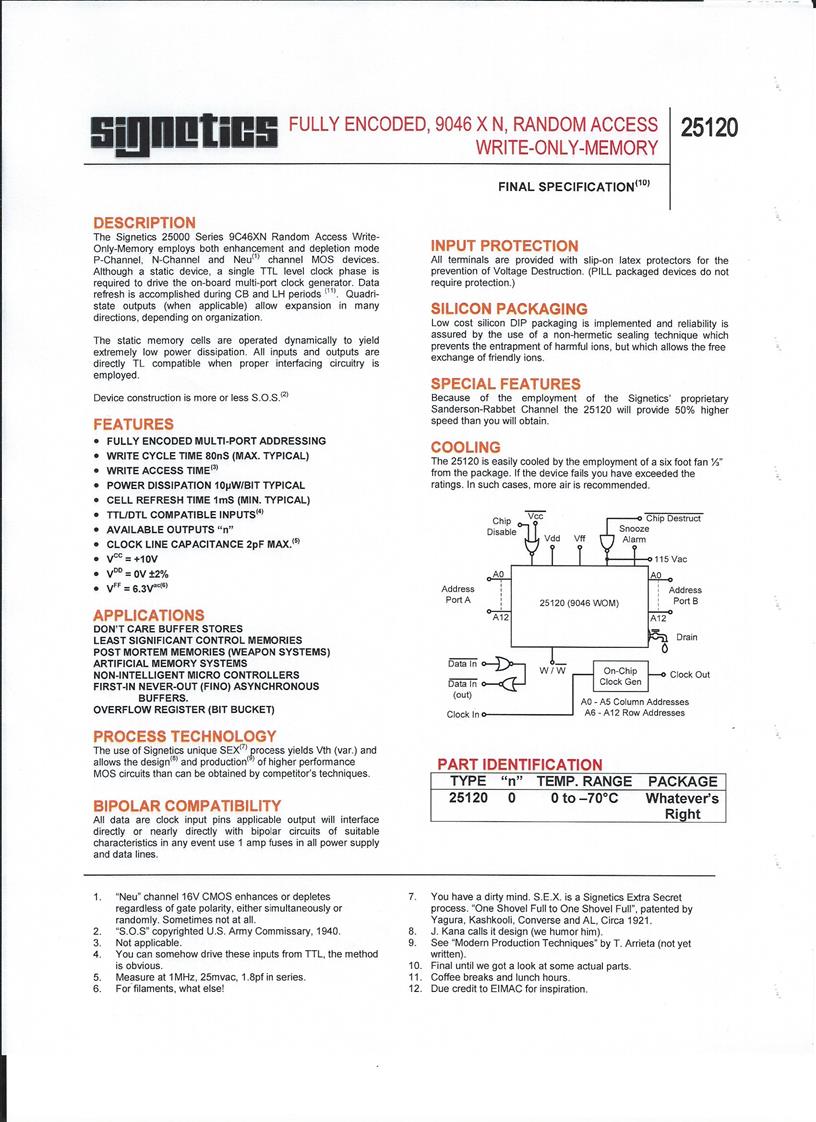
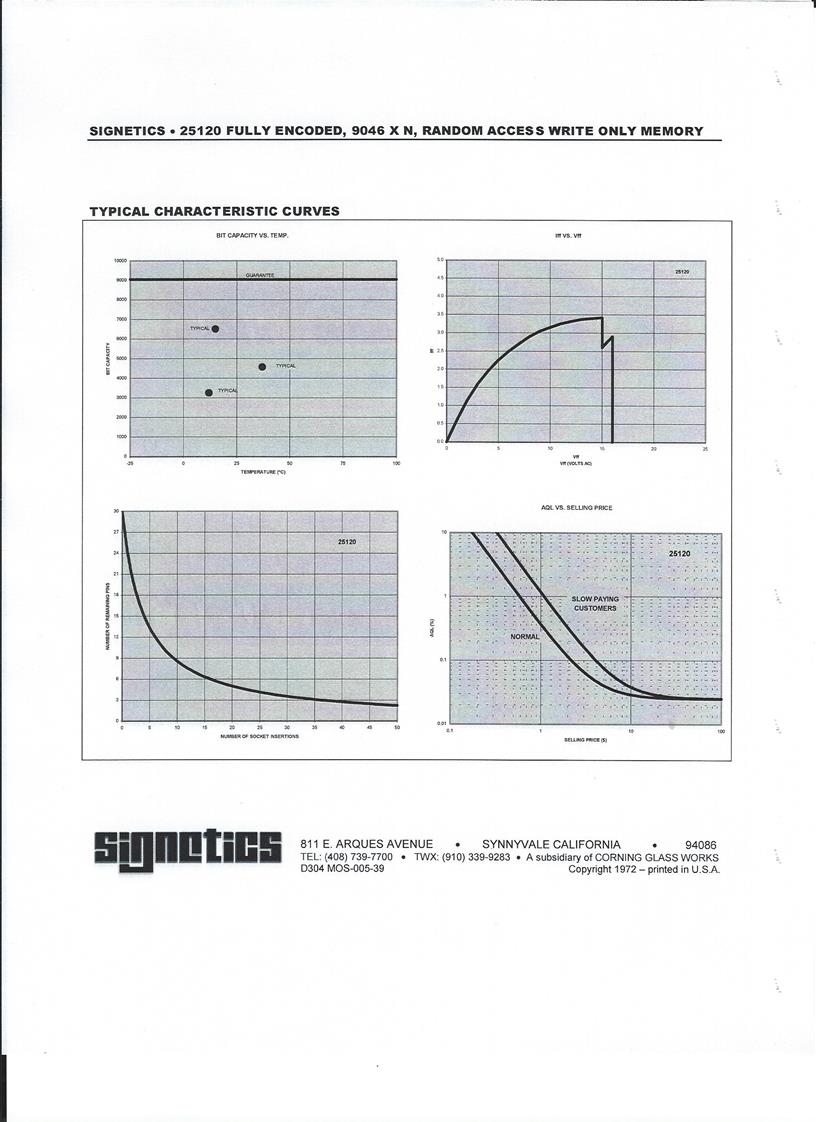
This is the historically classic data sheet for a Write
Only Memory produced by Signetics Engineers with too much time on their hands and probably written over
a long liquid lunch. This data sheet actually
slipped by the Signetics Quality Control managers and was published in a data book
before the “joke” was discovered. It has
become a classic in the semiconductor industry. I was never able to find out if
there was a subsequent employment issue with the engineers involved but things
were different in the industrial world in those days. Read it carefully including the footnotes
for this “Write Only Memory”
and enjoy!