EE
2212
PROBLEM
SET 1
S.
G. Burns
Due:
25 January 2017
Ø Unless
otherwise announced, I will collect the problem set when I collect the
associated quiz. It is also important to note that I often use homework
problems as part of the weekly quizzes. In collaboration with
Karin Larson (UGTA-Undegraduate Teaching
Assistant), some or all of the problems
on each problem set will be graded. Quiz
coverage will include material related to, and supporting the problem set as
well as material covered in class through the previous class period, usually
through Monday’s material. Any additions or deletions from quiz topical
coverage will be announced in class, via e-mail, and/or on the class WEB page. I strongly
encourage you to ask questions about the homework problems
during class and during
office visits. I also encourage you to ask for assistance on any
underlying and supporting topics from other courses. You may work together, and
I encourage you to do so, but remember you, and you
alone, are responsible for your work and you must turn in homework
individually unless otherwise noted. Material from laboratories may also be
incorporated in a quiz.
Ø ALL
QUIZZES are open book and notes. Laptops and tablets are OK, also
WEB access. Be careful on time
management when using the WEB during the quiz time. Be sure and bring your completed problem set
to class.
Ø Unless
otherwise noted, I use the two-person team quiz
active learning/cooperative learning pedagogy format. Please identify your quiz partner in
advance. It makes sense to also have
that same person
as your laboratory partner although that might not work out if you are in different laboratory
sections.
Ø You
may also elect to take quizzes individually
if that better suits your learning style.
Please let me know in advance so that I can prepare an adequate number
of copies.
Ø QUIZ
1, nominally 25 minutes long, will be given on Wednesday,
25 January, during the last portion of the class period.
Ø Also,
take the opportunity to study the text "Examples", which includes
solutions.
Ø I
also encourage that you read the Preface in the text to provide a broad
perspective on what topics are included in the text.
Ø Be
aware that you may often use different approximations and approaches to the
problem solution which may result in somewhat different (but very correct)
answers. Apply your skills in
engineering to evaluate the correctness of your answer and solution method
should there be a perceived discrepancy. One of my favorite sayings is, “Look
at you results with an engineering eye”.
Ø You
will need and use SPICE/PSPICE in EE 2212.
You may already have a copy from EE 2006. An evaluation version of SPICE
(PSPICE) is available from http://www.engr.uky.edu/~cathey/pspice061301.html
or from ORCAD http://www.cadence.com/products/orcad/pages/downloads.aspx
. The link http://www.pspice.com/ will also work.
Version 16.1 also works. The labs use version 9.1. Be sure you have a decent broadband
connection for a personal download.
PSPICE is also available on EE computers including those in MWAH 102 and
MWAH 391. Unfortunately, there is no
version of SPICE for iOS, only WINDOWS based machines. I keep looking for iOS versions. SPICE will work on an iOS machine if you install
a WINDOWS emulator.
Ø One
other issue which you should be aware of.
I use SYMBOL font in MSWORD,
and ADOBE fonts, as needed, in preparing WEB documents. I also use IE as my WEB browser. One reason I use MS WORD and IE is that they
are available through ITSS and are supported by UMD. There are cases where your personal generic
WEB browser and word processing program may not interpret SYMBOL font
correctly. This is especially true for
“shareware” and non-standard versions of word processing programs, including
Open Office, and versions of some operating systems such as
Firefox. Safari (Apple computers and the
iPAD) also has some issues. For example the Greek Omega symbol for ohms
which should print out as the Greek symbol Ω could print out as a W. This would occur if your printer driver
and/or word processing and/or font utility within your WEB browser were not set
up to accept SYMBOL, or in some cases ADOBE fonts. To the best of my knowledge, all the EE
computers using IE and MS products and printers are OK but your personal system
may not be. Please let me know if you
have this difficulty so I can try and work on fixes with you.
1.
Text 1.2,
1.3, 1.4, and 1.8 as a combination.
“Moore’s Law” plug-and-chug calculations; also a bit of practice in
working with exponentials. Do some WEB
surfing and compare your 2020 and 2021 numbers to what is now commercially available
in late 2016 and early 2017 for both the
number of transistors in a microprocessor and memory bits/chip. INTEL, Amdahl, Micron, and Apple products have some of this
information as far as these three
problems are concerned. Text 1.8 is another “Moore’s Law” type
question to think about. This reality check discussion
question is interesting. Look at your
numbers and units! Compare to the
approximate lattice spacing in a silicon crystal of 5.3 Å. Speculate on how the semiconductor industry could
address this fundamental physics issue.
2.
Text
1.44 This is a
3-bit Digital-to-Analog Converter. To do
this, you will need the basic inverting operational summing amplifier from EE
2006.
This is the Part (c) table to fill in.
|
Digital
Input |
Analog
Output |
|
000 |
|
|
001 |
|
|
010 |
|
|
011 |
|
|
100 |
|
|
101 |
|
|
110 |
|
|
111 |
|
Part
(d) as an addition which expands upon Text 1.44 concepts. A realistic problem since most of our digital
“toys” use 8-bit digitization for each color in a display or camera. For example, your smart phone or laptop
display consists of three colors-red, green, and blue. If each color is digitized with 8-bit
resolution, how many different colors can be displayed? What is your opinion on whether the human eye
can differentiate this number of colors?
Now
several problems in review of circuit analysis techniques from EE 2006. If any of the basic circuit concepts from EE 2006 are a bit
rusty, please ask questions either in
class or stop in my office. Also note
that Experiment 1, 19 January,
will also lean
heavily on understanding of EE 2006 topics.
3.
Text 1.21 and Text 1.22. Some plug-and-chug practice with Ohm’s Law
with an input independent voltage source.
Observe that fewer errors occur if you first solve the problem symbolically
before you substitute numbers.
So far you have solved Problem 3
with independent voltage sources. The next problem addresses dependent
sources. This problem includes
independent voltage and current sources , and dependent
current generators. Derive
an expression for the Thevanin equivalent circuits at
the indicated
nodes.
4. Text Problem 1.25 and Text Problem 1.28 as a
combination. Use symbolic notation; that
is do not substitute numerical values for the circuit elements; use the element
names such as R1, gm, etc. You need not provide numerical solutions.
5.
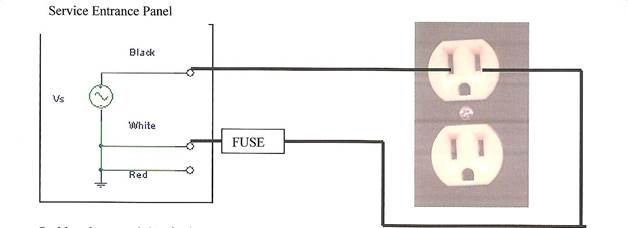
Let’s think about electrocution!!!
You were out partying with one of your electrical engineering student
friends (Best Friend Forever-BFF) from an unnamed large university located in
the Twin Cities. After the bars closed
at 2 am your “BFF” thought he was doing you favor and wired up a standard duplex
outlet for your apartment as a favor for buying a pitcher or two. Unfortunately, besides not doing well in the
large unnamed university in the Twin Cities equivalent to EE 2006 circuits course, and under the
influence of a large quantity of a variety of beverages, your “BFF” decided not
to follow the National Electric Code. (U.S. standards) Your “BFF”(?), made four errors, three of which could
potentially electrocute you!
(a)
Describe the four errors and explain how you
must fix them. You can mark up the
diagram appropriately or provide a separate series of diagrams.
(b) Identify
the three potentially
fatal errors and explain why they could lead to your
Electrocution (Be sure your tuition is paid up).
(c) Your
friend, who will probably get an F in the circuits class, decides to demonstrate his
circuits class
knowledge by plugging in a
lamp.
Will the lamp work? (YES, NO, PARTIAL INTENSITY, EXPLODE) Circle your
choice and explain your answer.
6. Write
peak and
rms
phasor notation (cosine reference)
expressions for the following signals.
Sketch the resulting phasor on the complex plane at t=0.
(a) V1(t) = 100 cos (500 t + 30°)
(b) V2(t) = 200 cos (500 t) + 100 cos (500 t + 30°)
(c) V3(t) = 100 cos (1000 t) + 100 cos (500 t + 30°) Be careful!
Explain why this is a trick question.
At least I warn
you about trick questions!
Now write the time domain function, assuming 60 Hz operation for
the following rms phasors; repeat if these two
expressions are peak
phasors. Reminder that ω =
2πf.
(d) Va = 100Ð30°
(e) Vb = 100
Now for the
important stuff from my extensive files of stuff. I hope you can handle it without getting sick