ECE 2212
PROBLEM SET 5
S. G. Burns
Due:
Wednesday, 22 February 2017
NOTE 1: Quiz 5 will cover topics associated with
Problems 1 through 4 and basic diode and rectifier circuits.
NOTE 2: Problem 6 is a
voltage regulator. We will complete our discussion
in Monday’s class.
1.
A 10 volt avalanche diode
has a thermal resistance of θJC = 4°C/watt.
The maximum junction temperature is 175°C operating at an ambient temperature
of TA=40°C. A heat sink with
6°C/watt of thermal resistance from the sink to ambient is used but must be
electrically isolated from the diode case with a thin mica washer having a
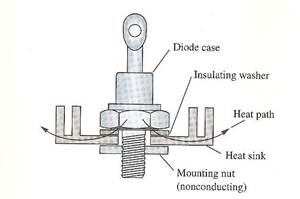
thermal resistance of 2°C/watt. See the
figure for an idea as to the heat flow path.
What is the maximum value of IZ and illustrate using a sketch
of the derating curve.
2. A power diode is rated at Imax = 6 A
and VJ = 0.7 volts. The case
temperature is not to exceed TC = 150°C. The thermal resistance θJC
= 4.25°C/W.
(a)
Estimate the junction temperature at maximum
case temperature.
(b)
If the ambient temperature is TA
= 30°C, what is the maximum thermal resistance, θCA,
of the heat sink?
3. (a) Refer to the
capacitance curves for the Motorola 1N4001.
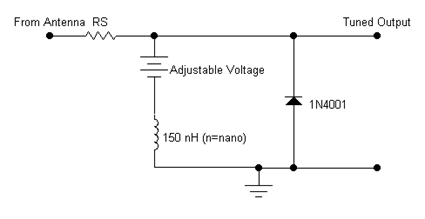
The input
tuning circuit of a standard analog FM radio is given below. Specify, that is design for, a voltage,
capacitance, and inductance required to tune the circuit to the center
frequency of KUMD-FM which operates at 103.3 MHz. Sketching and labeling a
representative resonance curve would be useful to support your calculations. There is no single correct design answer set
of values since it depends upon the voltage you initially select to tune your
diode.
(b) Repeat if you
use the Motorola MMBV109LT1 MV209.
4. Text Problem 3.1 but delete Part (d)
The following two problems must be
completed for the problem set but the associated topics will not be
incorporated in Quiz 5.
5. Text Problem3.75.
6. The iPhone 7 Li-ion Polymer battery is rated at 3.7 volts
with an energy
capacity of 5.3 watt-hours.
As an estimate, assume the standby/receive only current requirement is 5
mA and a transmit or WEB surfing current requirement is 200 mA. You
want to use your car’s power port which has a nominal and lowest output voltage
of 12 VDC although the voltage could go as high as 14.4 VDC when the engine and
alternator are running. Design an avalanche diode (Zener diode) voltage
regulator that will allow you to operate your iPhone 6 from the power port. Use
the discussion and circuit diagram discussed in our 17 and 20 February classes for
guidance. (Of course you wouldn’t use
your iPhone while
you were driving!!!!)
Your design
should include:
(a)
A well-labeled schematic diagram
(b)
Key design equations
(c)
Values
including power ratings for any resistor(s) needed.
(d)
Avalanche diode specifications that would
work including VZ, IZ(min),
IZ(max) and PZ.
(e)
Based
upon your design, answer the following questions (derived from an old quiz):
i.
IZ
is a maximum when the load resistance is (Lowest, Highest, Indeterminate). Circle your choice.
ii.
IZ
is a maximum when the input voltage is (3.7, 12, 14.4) volts. Circle your choice.
iii.
Would
your iPhone work
(YES, NO, MAYBE) if one of the cells in the car battery was dead and VIN dropped to 10 Volts? Circle your choice and briefly explain.
iv.
The
parametric form for a constant power contour when plotted on an I-V curve of
any device is (Linear, Parabolic, Cubic,
Hyperbolic). Circle your choice.
All
of these cartoons are relevant my life at UMD.
(1) I have my own coffee pot to avoid
issues.
(2) I have a slide rule collection and even know
how to use them. Stop in if you want a short course on how to
use a slide rule. Free lessons! In their day, prior to the early 70s, slide
rules were a great tool to learn about log10 theory and
applications. I have a few displayed in
my office. My HP 35 scientific
calculator I purchased as a poor graduate student was $400. Lots of Ramen noodles for a couple of months
but I had to have it!
(3) The iPAD and Macbook are so friendly and the graphics are great, but I
can’t find a good SPICE APP.
(4) For those of you who are aware of the current
UMD budget issues, the Dilbert cartoon says it all. ENJOY!


Recall the
WOM (Write-Only-Memory) Signetics Data Sheet from the attachment to the diode
circuits experiment, 16 February. The
fun-loving Signetics engineers may have
taken a clue from some engineers at EIMAC.
EIMAC manufactures high power and
specialty vacuum tubes used in high power transmitters and RF generators and
related. This is a data sheet for the “PHANTASATRON”. EIMAC is now a
subsidiary of Communications and Power Industries. Even though small vacumm tubes are no longer
made in the U.S., there are some manufacturers in Russia and Brazil catering to
the high end audiophile market. We will
talk about vacuum tube audio amplifiers towards the end of the semester. Larger, high power transmitting tubes and
speciality vacuum tubes are manufactured by EIMAC and others. Enjoy!