EE 2212
PROBLEM SET 8
S. G. Burns
Due: 29 March 2017
Note: EXTRA CREDIT OPPORTUNITY: Up to 30 Points added to your
end-of-the-semester Quiz Point Total. How do you earn this? I want
circuit diagrams and specifications for power amplifiers and
related equipment that you may have for some of your “stuff” and is usable,
that is, supports in-class discussions when we get to power amplifiers
towards the end of the semester. Information such as circuit diagrams,
specifications for your sound systems, guitar
amps, car stereos, powered sub-woofers, associated power supplies, speaker
systems, etc. I define power loosely in that information on your portable
electronics such as iPODs,mp3 players, smart
phones, tablets, etc. also is interesting to me and appropriate for class
discussion. I would like to borrow the material to supplement our class
discussions on power amplifier circuits. Do not just go to the WEB for
information that doesn’t relate directly to stuff you have. Hard Deadline
for receipt of materials is class on Monday, 10 April. Earlier is
better! Be sure your name is in the submitted materials. They will
be returned. I will award up to 30 points based upon relevance and
class usability and you describing the item and technical information to the class. The meaner and badder the better.
NOTE: Table 5.2 on Page 228 is a very important reference for
Problems 1 and 2
1. Text 5.36 for an npn and Text 5.40 for a pnp. Include skectches
of the bias voltages for each BJT.
2. This problem is an expanded version of Text 5.36. Complete the following
table. To support each of your table
entries, draw and label
a symbol of the npn transistor and
illustrate the junction bias conditions by showing the two diodes with the
appropriate bias conditions. Your Region
of Operation will be either forward-active, reverse-active, cutoff, or saturation.
Observe that the definition for saturation in a BJT is entirely different than the definition for saturation in a
FET!!!
For an npn BJT
|
VBE (in volts) |
VCE
(in volts) |
BE Junction Bias (Forward or Reverse) |
CB Junction Bias (Forward or Reverse) |
Region Of Operation |
|
+0.7 |
+5 |
|
|
|
|
-5 |
+5 |
|
|
|
|
+0.7 |
+0.2 |
|
|
|
|
-0.7 |
+5 |
|
|
|
3. This problem is an expanded version of Text 5.40. Complete the following
table. To support each of your table entries, draw
and label a
symbol of the pnp transistor and illustrate the
junction bias conditions by showing the two diodes with the appropriate bias
conditions. Your Region of Operation
will be either forward-active,
reverse-active, cutoff, or saturation. Observe that the
definition for
saturation in a BJT is entirely different than the definition for
saturation in a FET!!!
For a pnp
BJT
|
VBE (in volts) |
VCE
(in volts) |
BE Junction Bias (Forward or Reverse) |
CB Junction Bias (Forward or Reverse) |
Region Of Operation |
|
+0.7 |
-5 |
|
|
|
|
-0.7 |
-5 |
|
|
|
|
+0.7 |
+0.2 |
|
|
|
|
-0.7 |
-0.2 |
|
|
|
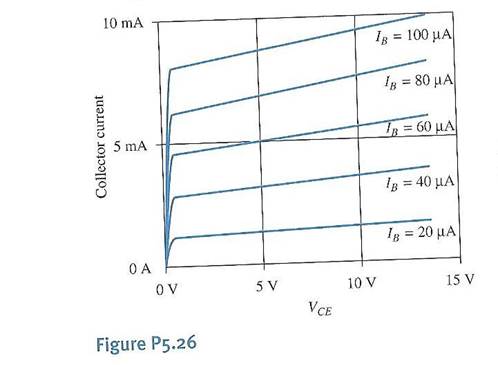
4. Refer to Text Figure P5.26 given below. Modify the default BJT SPICE model to
generate a set of curves that are a reasonable match to the characteristics
shown in Figure P5.26. Submit the BJT non-default
model parameters
and a copy of the characteristic curves that you obtained. Key parameters to change will be β and
VAF. We will discuss VAF in Monday’s
class.
4. Text 5.95. Parts (a), (b), (c), and
(d). Not Part (e)! Observe that you will have to derive an
equation for the base current by summing current at the collector
node.
5. Draw
and label the small-signal models for Figures P13.3 and P13.6 on Page 829. We will cover this in Monday’s class.
Alternate definition for bipolar
Alternate definition for dynamic range.
Time to register
for your Fall 2017 classes. The following are dedicated to those of you
having to register
for your breadth technical elective.


For Those of You Planning to take
Electromagnetics (EE 3445)
And We Don’t Want To Forget the CprE/CS Minor
To Support the Energy Engineering Minor
And Also Consider the Math Minor

And there is
always a UROP
and Senior Design!