ECE 2212 PROBLEM SET 1
S. G. Burns
Due: 15 September 2004
Unless
otherwise announced, I will collect the problem set. It is also important to
note that I often use homework problems as part of the weekly quizzes. I, in
collaboration with Sam Rud (UGTA and Grader) will grade some or all of the
problems on each problem set. Quiz coverage will include material related to
and supporting the problem set as well as material covered in class through the
previous class period. Any additions or deletions from quiz topical coverage
will be announced in class, via e-mail, and/or on my WEB site. I encourage you
to ask questions about the homework problems during class and in office visits.
I also encourage you to ask for assistance on any underlying and supporting
topics from other courses. You may work together, and I encourage you to do so,
but remember you, and you alone, are responsible for your work and you must
turn in homework individually unless otherwise noted. Material from
laboratories may also be included in quizzes.
ALL
QUIZZES are open book and notes. Be sure and bring your completed problem set.
QUIZ
1, nominally 20 minutes long, will be given on Wednesday, 15 September, during
the last portion of the class period.
Also,
take the opportunity to study the "Important Concepts In This
Chapter", "Examples", which includes solutions, and the
"Survey Questions".
Observe
that Appendix F includes some answers to selected problems. Also be aware that you may often use
different approximations and approaches to the problem which may result in
somewhat different (but very correct) answers.
Apply your skills in engineering to evaluate the correctness of your
answer and solution method should there be a discrepancy.
One
other issue which you should be aware of.
I use SYMBOL font in MSWORD, and ADOBE fonts, as needed, in preparing
WEB documents. There are cases where your WEB browser and word processing
program may not interpret this font correctly.
For example the Omega symbol for ohms which should print out as the
Greek symbol W could print out as a W. This
would occur if your printer driver and/or word processing and/or font utility
within your WEB browser were not set up to accept SYMBOL, or in some cases
ADOBE fonts. To the best of my
knowledge, all the ECE computers and printers are OK but your personal system
may not be. Please let me know if you
have this difficulty so I can work on fixes with you.
Some
review on phasors. Recall, we have
standardized on a cosine reference. I
encourage the use of polar to rectangular functions on your calculator but be
sure you set up the problem so that you minimize the chance of arithmetic errors.
1.
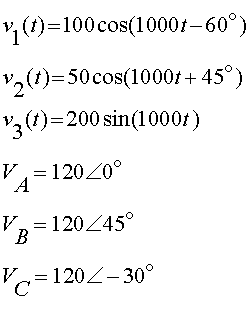
Define the following signals:

(a)
Write peak and rms
phasor notation for v1(t), v2(t), and v3(t).
(b)
Write both the peak and rms phasor representation for v1(t)+
v2(t)+ v3(t) and the resultant time domain equation.
(c)
What is the frequency associated with VA, VB,
and VC (Trick question).
(d)
Convert the rms phasors VA, VB, and VC
to the time domain at 60 Hz.
(e)
Convert the sum of VA, VB, and VC
to the time domain at 60 Hz. Part of your
answer should include a sketch of the vector sum of VA, VB,
and VC .
2. I used this question on a past quiz
covering basic ECE 2006 material.
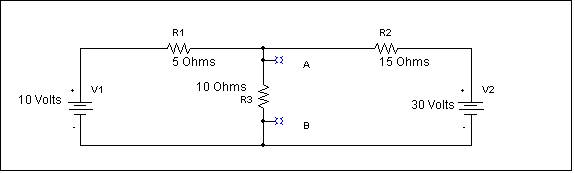
Consider the circuit shown below.
Label, with your sign conventions,
branch and loop (mesh) currents and voltages across all resistors. Using
appropriate circuit analysis techniques from ECE 2006:
(a)
Compute values for all branch and loop (mesh) currents.
(b)
Compute values for all voltages across resistors.
(c)
Draw and label the Thevanin and Norton equivalent circuits
at the A and B ports.
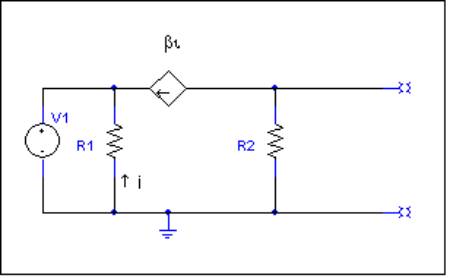
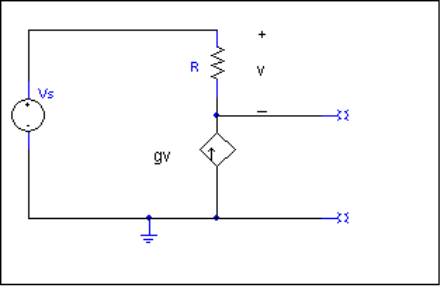
3. Draw and label the Thevanin and Norton equivalent circuits for each of the following two circuits. Observe that you must treat the current controlled and voltage controlled generators correctly!
(If any of the basic circuit concepts from ECE 2006 are a bit rusty
(i.e., superposition, Phasors, Kirchoff’s Laws, loop and nodal analysis, please
ask questions either in class or stop in my office)
Now some
practice with the decibel.
4.
For the cascaded network shown
below

Assume
v1(t) = 50cos(wt - 25°) mV A1 = 10 ej45° A2 = |A2| ej60° A3
= 0.25 e-j180°
|V3/V2|dB = 30 dB
(a)
What is the voltage gain of
|V2/V1| in dB?
(b)
What is the value of |A2|?
(c)
What is the voltage gain of
|V4/V1| in dB?
(d)
Write an expression for v4(t)
(e)
What is the total phase shift through the network?
LABORATORY INFORMATION
We
will start labs Thursday, 16 September.
You
also must have a patent-style notebook and blank PC-formatted 3 ½ diskettes
with you when you come to lab. I also
suggest you use your prototyping boards you used in ECE 1315 rather than the
larger boards in lab to minimize noise.