UMD Home > CLA > Sociology-Anthropology  > Anthropology > Tim Roufs > Global Cultures
View of Earth from Outer Space
explore -- Lonely Planet
EU Countries

UMD   Skip to the Contents A B C D E F G H I J K L M N O P Q R S T U V W X Y Z  
Week: 01 . 02 . 03 . 04 . 05 . 06 . 07 . 08 . 09 . 10 . 11 . 12 . 13 . 14 . 15 . 16

Understanding Global Cultures

Tuesday, 13-May-2008 06:08:53 GMT
Today in History
Today in Headlines

UM One Stop

Word of the Day

Fall 2006 Calendar

World Clock

search links page
~ Google advanced
~ Google images

search on JSTOR

Wikipedia

BBC News

GCforum    presentations schedule   topics and resources

see also Peoples and Cultures of Europe

List of countries of the world -- Wikipedia

Google Search: Society > Ethnicity >
Google Search: Science > Social Sciences > Area Studies >

language dictionaries

Babel Fish Translation
~ translate this page

Tech Resources
for Students

Cutting Costs for College Textbooks -- NPR

general textbook information

Texts:

On-line Resources (see also individual entries below):

to top of page / A/Z index   to top of page / A-Z index

Available used from about $20.00

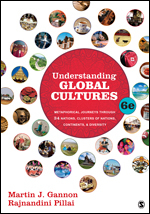
Textbook: Understanding Global Cultures

Understanding Global Cultures:
Metaphorical Journeys Through 28 Nations
, Third Edition


Author: Martin J. Gannon : California State University San Marcos

Published By: SAGE Publications, Thousand Oaks, CA, 2004

Pages: 458

Paperback (ISBN 0761929800)

Description:

This book describes a method, the cultural metaphor, for understanding easily and quickly the cultural mindset of a nation and comparing it to those of other nations. In essence, the method involves identifying some phenomenon, activity or institution of a nation’s culture that all or most of its members consider to be very important and which they identify closely. Metaphors are not stereotypes. Rather, they rely upon the features of one critical phenomenon in a society to describe the entire society. The characteristics of the metaphor then become the basis for describing and understanding the essential features of the society. For example, the Italians invented the opera and love it passionately. Five key characteristics of the opera are the overture, spectacle and pageantry, voice, exteriority, and the interaction between the lead singers and the chorus. These features are used to describe Italy and its cultural mindset. Thus the metaphor is a guide or map that helps the student of foreigner understand quickly what members of a society consider to be very important.

In the new edition of Understanding Global Cultures the generic types of cultural frameworks developed by Triandis and Fiske, and the torn and cleft culture framework developed by Huntington, form the underpinning of the book. These frameworks allow the reader to gain new insight into various cultural metaphors and to begin to address the challenging issue of integrating cultural and economic perspectives.

to top of page / A/Z index   to top of page / A-Z index

Understanding Global Cultures
Table Of Contents

Afghanistan

[Afghanistan] [your-nation.com] [OnlineNewspapers.com]

Preface

I. Introduction

1. Understanding Cultural Metaphors

II. Authority Ranking Cultures

2. The Thai Kingdom

3. The Japanese Garden

4. India: The Dance of Shiva


5. Bedouin Jewery and Saudi Arabia

6. The Turkish Coffehouse


7. The Brazilian Samba


8. The Polish Village Church

9. Kimchi and Korea

to top of page / A/Z index   to top of page / A-Z index

III. Equality Matching Cultures

10. The German Symphony

11. The Swedish Stuga

12. Irish Conversations

13. The Canadian Backpack and Flag

14. The Danish Christmas Luncheon


15. French Wine

IV. Marketing Pricing Cultures

16. American Football

17. The Traditional British House

to top of page / A/Z index   to top of page / A-Z index

V. Cleft National Cultures

18. The Malaysian Balik Kampung

19. The Nigerian Marketplace


20. The Israeli Kibbutzim and Moshavim


21. The Italian Opera


22. Belgian Lace

VI. Torn National Cultures

23. The Mexican Fiesta

24. The Russian Ballet

to top of page / A/Z index   to top of page / A-Z index

VII. Same Metaphor, Different Meanings

25. The Spanish Bullfight

26. The Portuguese Bullfight

VIII. The Base Culture and Its Diffusion Accross Borders

27. China's Great Wall and Cross-Cultural Paradox

28. The Chinese Family Altar

29. The Singapore Hawker Centers

IX. Perspectives on Continents

30. Australian Outdoor Recreational Activities

31. The Sub-Saharan Bush Taxi


to top of page / A/Z index   to top of page / A-Z index

Available used from about $22.00

Textbook:  Distant Mirrors: America as a Foreign Culture

Distant Mirrors: America as a Foreign Culture, Third Edition

Authors: Philip R. DeVita (State University of New York, Plattsburgh) & James D. Armstrong (State University of New York, Plattsburgh) (eds.)

Published By: Wadsworth Thomson Learning, Belmont, CA, 2002

Pages: 197

Paperback (ISBN 0534556485)

Description:

The book is intended for use as a supplement for courses in cultural anthropology, sociology, history, English, and American studies. It is designed for any course where the goal is to show remarkable aspects of our U.S. culture. The book covers the subjects of family, kinship, class, and language. It is valuable to professors who want to teach such topics as ethnocentrism and relativism, the problems of cross-cultural experiences, and the ethnographic method.

Anthropology has a long history of the "other," yet we can look right here at home for the strangeness we seek. We often neglect to ask the questions that reveal our own culture's underlying value and beliefs. In this volume, we bring the American culture into focus. For students to understand the full impact of ethnography, to experience cultural relativity and to gain a foundation to build informed comparisons, students need a firm grasp of their own culture--and need to use this volume. The Third Edition consists of 19 essays written by anthropologists and other scholars using an ethnographic perspective. The essays enable students to understand themselves better by focusing on their own culture and seeing it from a new perspective. This collection gives anthropology a comparative perspective that provides a reflective lens, a mirror, for understanding ourselves and the world in which we live.

to top of page / A/Z index   to top of page / A-Z index

Distant Mirrors
Table Of Contents

1. "One Hundred Percent American" by Ralph Linton
[American Cultural Anthropologist]


2. "The American Cultural Configuration" by Lowell D. Holmes and Ellen Rhoads Holmes
[American Cultural Anthropologists]


3. "Body Ritual among the Nacirema" by Horace Miner
[American Cultural Anthropologist]


4. "Professor Widjojo Goes to a Koktel Parti" by Weston LaBarre
[American Psychiatrically Oriented Anthropologist]


5. "An Outsider's View of American Culture" by Janusz L. Mucha
[Polish Sociologist]


6. "Growing Up American: Doing the Right Thing" by Amparo Ojeda
[Philippine Anthropological Linguist
]

7. "My American Glasses" by Francisco Martins Ramos
[Portuguese Anthropologist]


8. "American Graffiti: Curious Derivatives of Individualism" by Jin Kim
[South Korean Communication Professor]


9. "The Young, the Rich, and the Famous: Individualism as an American Cultural Value" by Poranee Natadecha-Sponsel
[Thai Philosopher]


10. "America and I" by Herve Varenne
[French Anthropologist and Professor of Education]


11. "Encounters with the Elderly in America" by Yohko Tsuji
[Japanese Anthropologist]


12. "Neighborly Strangers" by Honggang Yang
[Chinese Applied Anthropologist]


13. "Pais de Mis Suenos: Reflections on Ethnic Labels, Dichotomies, and Ritual Interaction" by Gisela Ernst
[Peruvian Anthropological Linguist]


14. "Giving, Withholding, and Meeting Midway: A Poet's Ethnography" by Saleem Peeranina
[Indian Poet]


15. "A Russian Teacher in America" by Andre Toom
[Russian Mathematician]


16. "First Impressions: Diary of a French Anthropologist in New York City" by Francoise Dussart
[French Anthropologist]


17. "Life and Cultures: The Test of Real Participant Observation" by E. L. Cerroni-Long
[Italian Anthropological Asian Studies Scholar]

18. "Learning to Hug: An English Anthropologist's Experiences in North America" by Geoffrey Hunt
[English Anthropologist]


19. "A European Anthropologist's Personal and Ethnographic Impressions of the United States" by Emanuel J. Drechsel
[Swiss Anthropologist]

to top of page / A/Z index   to top of page / A-Z index

Features:

  • Keeps theoretical language to a minimum to enhance readability

  • The articles are selected for their captivating, and often humorous, critical view of American culture

  • Challenges students to look at their culture with a fresh perspective, helping them to realize that what is routine for Americans is not elsewhere

  • Short introductory paragraphs preface each reading, conceptualizing the essays within anthropological methodologies, theories, themes, etc.

  • Study questions follow each reading to enhance student understanding the concepts presented

  • Wadsworth Anthropology Video Library! Qualified adopters may select full-length videos from an extensive library of offerings drawn from such excellent educational video sources such as NOVA, Films for the Humanities and Sciences, The Disappearing World Video Series

  • The latest news and research articles online, updated daily and spanning four years! Choose to package InfoTrac College Edition with this text and you and your students will have 4-months of free access to an easy-to-use online database of reliable, full-length articles (not abstracts) from hundreds of top academic journals and popular sources. Contact your Wadsworth/Thomson Learning representative for more information. Available to North American college and university students only. Journals subject to change.
to top of page / A/Z index   to top of page / A-Z index

Continue on to the Course Summary Page

Registration


Last Modified Thursday, 21-Feb-2008 13:17:29 CST

Envelope Image © 1998 - 2008 Timothy G. Roufs
Page URL: http:// www.d.umn.edu /cla/faculty/troufs/anth1095/index.html
Last Modified Thursday, 21-Feb-2008 13:17:29 CST
Site Information ~ Main A-Z Index


View Stats