The Midterm Exam will be an open-book / open-notes essay exam
made up of the questions on the annotated Study Questions Page?You may bring and use your texts, dictionary, thesaurus, a writing handbook, class handouts, notes, outlines, drafts, memos, and a Ouija board. You may also use references and materials from your other classes and the web, with the caveat, of course, that you properly cite any sources you use.
This includes the lecture materials, class videos, E-mails,
the GC Canvas Discussions,
the basic introductory materials of the texts,
and the text and class materials
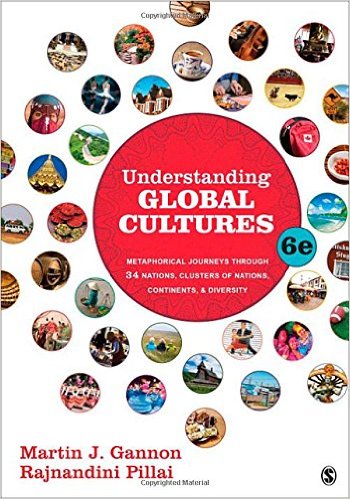
Understanding Global Cultures: Metaphorical Journeys Through 34 Nations, Clusters of Nations, Continents, and Diversity, Sixth Edition
(Thousand Oaks, CA: SAGE Publications, 2015)
Preface: Understanding Cultures in Depth
PART I: INTRODUCTION
Chapter 1: Understanding Cultural Metaphors
PART XII: SAME METAPHOR, DIFFERENT MEANINGS
Chapter 34: The Spanish Bullfight
Chapter 35: The Portuguese Bullfight
Pick at least one of the following "Authority Ranking Cultures" . . .
Will I be able to see all of the questions at once?
Yes.
In this class you can see all of the questions at one time. With the Canvas system exams can be set so that you can only see one question at a time, so it is a good idea to check.
Will I be able to return to a question during the exam?
Yes.
In this class you can actually move back and forth among questions, if you want to. With the Canvas system exams can be set so that you can move around from question to question, or not, so it is a good idea to check.
Whenever you move—to the next question, or back and forth among the questions—be sure to save your work before leaving the question you are on.
How long should your answers be?
Answer: About two-thirds the length of Lincoln's Gettysburg Address
The question of length is a good one. It's also a difficult one to answer as it depends on the question itself, your style of writing, the detail which you give to your examples, and—since this is an open-book exam where you basically could prepare questions in advance and then cut and paste from other sources (with proper credit given to those sources)—a good answer can vary quite a bit in length.
At a minimum you should have a beginning, a middle, and an end (sometimes also known as introduction, body, conclusion).
You should also be sure to answer the question(s) asked, and if there are two, three or more parts to a question, be sure to answer all of them.
Be sure to give examples when you make a statement.
I think it is a good thing to have a look at the OWL's advice before every exam:
To use their recommendations, a well focused, well organized, well supported, well packaged essay answer could be done (for most of the questions) in the equivalent of about a page and a half to two "normal" pages (double-spaced, one-inch margins, #11 or #12 font)—which is about 375-500 words.
How long was the Gettysburg Address?
263 or 268 or 270 words depending on which printed version you check
A standard "letter size" 8-1/2 X 11 sheet of paper has about 255 words, with a size 12 font
So your answer should be about three-fourths to one page long, two if you use the Owl's recommendations.
BONUS QUESTION: How long was the other most famous U.S.A. political speech, "I Have a Dream", by Martin Luther King, Jr.?
ANSWER: The Reverand King was scheduled to talk for 4 minutes, and he talked for 17 minutes; his speech was speech was 6 pages of text running 1,667 words.
So your exam question needs to be no longer than 15% the length of Martin Luther King, Jr.'s "I Have a Dream" speech.
REM: Be Sure to Discuss items . . .
When an essay question asks you to discuss one or more items or features, that first of all does not mean to simply listing things.
It is OK to begin your answer essentially with a list of what you intend to discuss, but listing is only the beginning.
There are many ways to discuss an item or feature. Some time-honored recommended strategies include using/following . . . :
The Journalist's Questions
Who
(descriptive)
What
(descriptive)
When
(descriptive)
Where
(descriptive)
How
(analytic)
Why
(analytic)
And you can do this for more than one subtopic
For example, you could have one set of "Journalist's Questions" for women's reality and a separate set for men's reality
And you could have still another for widows, etc., . . .
Time Sequence
T1 ---> T2 ---> T3 ---> T4 ---> . . .
(In this case T1, etc., can equal scenes in the video, for example)
Space Sequence
S1 ---> S2 ---> S3 ---> S4 ---> . . .
(In this case S1, etc., could equal the spacial scenes in the video)
(In other cases -- but not so easy to do with the information provided in this film -- with S1, etc., you could describe situations East to West, for example)
"The most important partition of . . . between Kypseli men and women is. . . ."
"Next in importance to the men is . . . while women. . . ."
"The least important to the men in Kypseli is . . . while women. . . ."
Comparison / Contrast
Note how things are the same and how they are different. In the Kypseli case, a logical comparison / contrast would be with / between "The Divided Reality" of the women's world and the men's world.
Women
Men
Item # 1
similar
different
similar
different
Item # 2
similar
different
similar
different
Item # 3
similar
different
similar
different
Item # 4
similar
different
similar
different
Item # N
similar
different
similar
different
Emic (the "insider's" view) / Etic (the "outsider's" view)
Ethnography (description) / Ethnology (analysis)
Be sure to give to your examples, and—since this is an open-book exam where you basically could prepare questions in advance and then cut and paste from other sources (with proper credit given to those sources)—a good answer can vary quite a bit in length.
At a minimum you should have a beginning, a middle, and an end (sometimes also known as introduction, body, conclusion).
You should also be sure to answer the question(s) asked, and if there are two, three or more parts to a question, be sure to answer all of them.
Be sure to give examples when you make a statement.
I think it is a good thing to have a look at the OWL's advice before every exam:
Your exam will have four questions. They will be selected from the questions that appear on the Study Questions Page.
Moodle will give you four of those questions at random after you sign on to the exam.
Pay attention to the annotations as the original questions are quite often modified to make them a bit clearer, or a little easier to answer in 15 minutes (about the amount of time you will have per question), or to ask for your personal opinion and / evaluation . . .
Will all of the questions in the Study Questions Page be included?
No.
Not all of the questions on the Study Questions Page will be in the pool for the exam. Duplicate questions, or questions that are essentially duplicate questions, will not be included; that is to say that there will be only one question in the pool on any given central topic.
Also, some questions are better questions for the Final Exam. If in my annotations it says something like, "this would be a better question for the Final Exam" that means that it will not be in the question pool for the Midterm Exam. (That does not mean that it will be in the pool for the Final Exam, it just means that it will not be in the Midterm Exam question pool).
Other words of advice?
If I were preparing for the exam (an open-book/open notes exam) I would focus on the Wiki Study Questions, paying special attention to the annotations.
I would also read over the Weekly Memos (in this case the Memos for Weeks 1-6).
And I would review the text materials (see above) and the materials from the in-class videos and slides.
The Midsemester exams will be four (4) open-book
essay exams selected by Moodle at random from a list of questions, most of which will be condtributed by members of the class
Essay exams usually provide a better learning experience
and, in addition, afford practice in writing
This is an open-book / open-notes exam
You may bring and use your texts,
dictionary, thesaurus, a writing handbook, class handouts,
notes, outlines, drafts, and memos
You may also use references and
materials from your other classes, with the caveat, of
course, that you properly cite any sources you use
Use of AI-content generators for assignments in this class
When I taught Advanced Writing for the Social Sciences here at UMD, for over twenty-five years, my rule of thumb advice to students was to plan to spend 60% or more of their time and effort revising drafts (for academic type writing).
In 2001 Wikipedia appeared on the scene and very quickly became a useful tool asa starting point for many academic projects even though as an open-source resource the Wikipedia entries are not checked and verified in the same manner as other traditional reference materials.
Spelling and grammar checkers arrived on the general scene and helped with spelling and grammar checking, but, as you no doubt have discovered, they continue to require human editing.
And, of course, before that we had a selection of excellent Encyclopedia offering good starting points for many projects, the most popular being The Encyclopedia Brittanica.
And long before that there were libraries--since at least the days of Alexandria in Egypt, in the third century B.C.
The bottom line . . .
Today the evolution of research resources and aids continues with the relatively rapid appearance of ChatGPT and other automated content generators.
As many folks have already found out, they can be very useful as starting points, much like their predecessors. But, from the academic point of view, they are still only starting points.
Professors nationwide are for the most part advised, and even encouraged, to experiment with the potentials of ChatGPT and similar apps.
In this class it is fine to experiment, with the caveat that all of your written academic work demonstrates that your personal efforts—including content development and revision—reflect your personal originality, exploration, analysis, explanation, integrating and synthesizing of ideas, organizational skills, evaluation, and overall learning and critical thinking efforts.
That is to say you may experiment with the AI tool to do tasks such as e.g, brainstorming, narrowing topics, writing first drafts, editing text, and the like. AI-generated works should in no case be more than that.
In the end you need to become familiar enough with the various subjects, peoples, and places discussed in this class to research a topic and problem-solve on your own, and carry on an intelligent conversation about them in modern-day society . . . a conversation that goes byond your voicing an unsupported opinion.
For the record, what follows is the official UMD Academic Integrity Policy. Note that "unless otherwise noted by the faculty
member" this is the default policy.
"UMD’s Academic Integrity policy covers any work done by automated content generators such as ChatGPT or other generative artificial intelligence tools unless otherwise noted by the faculty
member. These tools present new challenges and opportunities."
"Within the confines of this
class The use of AI-content generators is strictly prohibited for any stage of homework/assignment
(e.g., draft or final product). The primary purposes of college are developing your thinking skills,
being creative with ideas, and expanding your understanding on a wide variety of topics. Using
these content generating AI tools thwarts the goal of homework/assignments to provide
students opportunities to achieve these purposes. Please make the most of this time that you
have committed to a college education and learn these skills now, so that you can employ them
throughout your life." -- Jennifer Mencl, UMD Associate Vice Chancellor, Academic Affairs, 10 May 2023
"Academic dishonesty
tarnishes UMD's reputation and discredits the accomplishments
of students. UMD is committed to providing students
every possible opportunity to grow in mind and spirit.
This pledge can only be redeemed in an environment
of trust, honesty, and fairness. As a result, academic
dishonesty is regarded as a serious offense by all
members of the academic community. In keeping with
this ideal, this course will adhere to UMD's Student
Academic Integrity Policy, which can be found at www.d.umn.edu/assl/conduct/integrity.
This policy sanctions students engaging in academic
dishonesty with penalties up to and including expulsion
from the university for repeat offenders." --
UMD Educational Policy Committee, Jill Jensen, Chair
(08/16/2007)
"The instructor
will enforce and students are expected to follow the
University's Student Conduct Code (http://www.d.umn.edu/assl/conduct/code).
Appropriate classroom conduct promotes an environment
of academic achievement and integrity. Disruptive
classroom behavior that substantially or repeatedly
interrupts either the instructor's ability to teach,
or student learning, is prohibited. Disruptive behavior
includes inappropriate use of technology in the classroom.
Examples include ringing cell phones, text-messaging,
watching videos, playing computer games, doing email,
or surfing the Internet on your computer instead of
note-taking or other instructor-sanctioned activities."
-- UMD Educational Policy Committee, Jill Jensen,
Chair (08/16/2007)



 Modules
 for Class Participants Spring 2026 [calendar]