UMD  
UMD 
Skip to the Contents A B C D E F G H I J K L M N O P Q R S T U V W X Y Z

explore the world
-- Lonely Planet

Envelope: E-mail


Tech Resources for Students

search links
~ Google advanced

BBC News: Americas 

Monday, 09-Nov-2009 05:48:07 GMT
. . . in History
  . . . in Headlines


UM One Stop
more on J-Store

      Babel Fish Translation
~ translate this page

Cutting Costs for College Textbooks

general textbook information

OWL logo, Online Writing Lab, Purdue University.


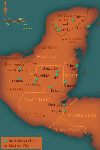
Map of Major Mayan Archaeological Sites

Map of the
Mayan World

-- NOVA

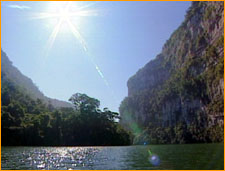
Rio La Venta, not to be confused with the Olmec site of La Venta on the Tonala River.
Rio La Venta
in the state of Chiapas
(Not to be confused with
the Olmec site of La Venta
on the Tonala River, in the state of Tobasco, Mexico)

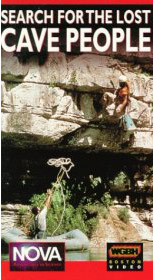
Search for the Lost Cave People video.


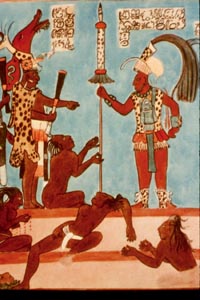
Detail of Bonampak Mural

Detail of Bonampak Mural

Partially-excavated remains of a child.

Partially-excavated remains of a child

Zoque cloth.

Zoque cloth

to top of page / A/Z index   to top of page / A-Z index

"Deep in the wilds of southern Mexico lies a river canyon surrounded by a jungle so forbidding that it was one of the last untouched archaeological sites in the world, which proved to be the location of a lost civilization."

"In 1997, an international group of archaeologists ventured into the Chiapas region of Mexico to search for the remains of a little-known civilization that preceded the Maya. In caves hundreds of feet above the Rio la Venta, and in an ancient complex swallowed by the jungle, the team found astonishing archaeological treasures."


"The Maya are often credited with inventing the first complex writing system on the American continent, but recent archeology shows that a little-known people called the Zoque developed a sophisticated script long before the Maya. Who were the Zoque? Were they responsible for such technological advances as a calendrical system and sophisticated numerical systems?"

"Some 300 caves carved into canyon walls in the Rio la Venta Gorge, located in the Chiapas jungle in Central America, may hold some answers. The relative inaccessibility and extreme dryness of the caves have preserved clothes, rope, and wooden implements -- artifacts that rarely survive in Central America. NOVA follows a team of archeologists as they uncover artifacts that could reveal new understandings about the Zoque and their place in Mesoamerican history." -- NOVA

to top of page / A/Z index   to top of page / A-Z index
Terms / Concepts:

  • coprolites

  • cranial deformation

    • a widespread practice in Mesoamerica
    • head binding was common and followed fashion and aesthetics
    • different people adopted different styles

  • religious syncretism

    • celebration
to top of page / A/Z index   to top of page / A-Z index
Notes:
  • First complex writing system on the American continent was deciphered using a four-ton Zoque stela pulled from a river bed in 1986

  • caves important to the Maya

    • "In Mesoamerican culture, caves were passageways to an underworld inhabited by ancestors and gods. "

    • when the sun set in the West it entered this area to engage in battle

      • to ensure that it would be victorious and rise again there needed to be the sacrifice of human blood

  • "The jaguar gods in Mesoamerica were linked to caves and the underworld. They took many forms."

  • pyrite mirrors part of the grave offerings

    • may once have been used to see a spirit world

  • 900+ year-old cotton cloth was part of the grave offerings

  • the clean-cut opening in the skull suggests ritual meal of sacrifical victim

  • sacrifical victim took the place of the gods

  • they were really consuming the flesh of the gods

  • incense burners were often used at the end of blood-letting rituals


to top of page / A/Z index   to top of page / A-Z index
Cultures:

to top of page / A/Z index   to top of page / A-Z index

Sites:

to top of page / A/Z index   to top of page / A-Z index
Individuals:

Tullio Bernobei (cave expert)

Andrea Drusini (physical anthropologist)

Thomas Lee (archaeologist)

Eliseo Linares Villanueva (Mexican archeologist)

Giuseppe Orefici (expedition leader)

Luigi Piacenza (paleobotanist)

to top of page / A/Z index   to top of page / A-Z index

Publications:

Teacher's Guide Resources

Up arrow.   to top of page / A-Z index

Envelope: E-mail © 1998 - 2010 Timothy G. Roufs
Page URL: http://www.d.umn.edu /cla/faculty/troufs/anth3618/video/Lost_Cave_People.html
Last Modified Wednesday, 22-Oct-2008 22:46:32 CDT
Site Information ~ Main A-Z Index


View Stats