| |
|
|
|
|
Wednesday 27 February 2008
Week 06 Day 11
video clip: "ESP"
(13 min., 1998)
|
|
Announcements
-
The midsemester exam will be on Day 13, Wednesday, 5 March 2008 rather than on Day 12, Monday, 3 March 2008
|
Features of the Day
video clip: "ESP"
(13 min., 1998)
- Dr. Edwin May, "Remote Viewing" Houston experiment
- with visual agnosia you have percepts without concepts
- with ESP do you have concepts without percepts?
- For investigations on Paranormal Phenomena see
|
-
- Questions about the Midsemester Examination?
The midsemester exam will be on Day 13, Wednesday, 5 March 2008 rather than on Day 12, Monday, 3 March 2008

- Non-Everyday Cognition: Parapsychology includes...
- Psychokinesics
- "movement from the mind"
- aks telekinesis
- ESP
- video clip: "ESP"
(13 min., 1998)
- Dr. Edwin May, "Remote Viewing" Houston experiment
- with visual agnosia you have percepts without concepts
- with ESP do you have concepts without percepts?
- For investigations on Paranormal Phenomena see
- Everyday Cognition
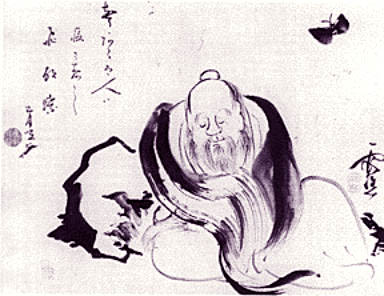
"Last night I dreamed I was a butterfly.
How do I know that I am not a butterfly now dreaming I'm a man?"
"Once Zhuangzi dreamt he was a butterfly, a butterfly flitting and fluttering around, happy with himself and doing as he pleased. He didn't know he was Zhuangzi. Suddenly he woke up and there he was, solid and unmistakable Zhuangzi. But he didn't know if he was Zhuangzi who had dreamt he was a butterfly, or a butterfly dreaming he was Zhuangzi. Between Zhuangzi and a butterfly there must be some distinction! This is called the Transformation of Things." -- (2, tr. Burton Watson 1968:49)
[From The Taoist book "Zhuangzi dreamed he was a butterfly" (莊周夢蝶 Zhuāng Zhōu mèng dié) -- Wikipedia]
莊子
Zhuangzi (Chuang Tzu)
(4th Century B.C./B.C.E.)
"Zhuangzi's philosophy was very influential in the development of Chinese Buddhism, especially Chán (also known as Zen)."
Cognition = Perception + Conception
Stranger in the Mirror: An Examination of Visual Agnosia
(60 min., 1993, VC 2464)
[From NOVA ]

Cognition = Perception + Conception
| cognition |
perception |
sensory |
vision |
"per-cepts" |
| hearing |
| touch |
| taste |
| smell |
extra - sensory
(ESP) |
6th ? |
"?"
|
| conception |
|
|
"con-cepts" |
Cf., "Foundations of Cultural Knowledge," in Culture and Cognition: Rules, Maps, and Plans
(San Francisco, CA: Chandler, 1972), pp. 3-38.
- Questions:
- What is re - cognition?
- And re - cog - nize?
- And "pattern re-cognition?"
- And "pattern re-cogni-za-tion?"
- What is re - call?
- And "pattern re-call?"
- And "pattern re-call-i-za-tion?"
- Or is it "pattern re-call-ing-i-za-tion?"
- How does "phantom pain" enter into this?
- How does "synaesthesia" fit in?

How one synaesthete sees 'Saturday'
| cognition |
perception |
sensory |
vision |
"per-cepts" |
| hearing |
| touch |
| taste |
| smell |
extra - sensory
(ESP) |
6th ? |
"?"
|
| conception |
|
|
"con-cepts" |
Cf., "Foundations of Cultural Knowledge," in Culture and Cognition: Rules, Maps, and Plans
(San Francisco, CA: Chandler, 1972), pp. 3-38.
- How does aesthetics fit in?
- And an-esthetics?
|
.
A tiny little wee abridged short synoptic
précis introduction to
(or, a sneak preview of coming attractions of the middle third of the semester . . .)
Perceptual and Conceptual Cognitive Processes
.
Per-cept--ual and Con-cept--ual Cog-ni[to]--tive Processes
Percept--ual and Concept--ual Cogni--tive Processes
REM: Cognition = Perception + Conception
Cogni-tion = Per-cept-ion + Con-cept-ion
Cogni-tion = Percept-ion + Concept-ion
.
REM from a few weeks ago?:
per-son-ality
through - the sound - the essence or quality of

Dionysus,
Greek Theatrical Mask
Cognition = Perception + Conception
Cogni-tion = Per-cept-ion + Con-cept-ion
Cogni-tion = Percept-ion + Concept-ion
.
.
- Orientation to Cog-nition: Per-ception and Con-ception
"Latin: 'I am thinking, therefore I exist', or traditionally 'I think, therefore I am') is a philosophical statement by René Descartes, which became a foundational element of Western philosophy. 'Cogito ergo sum' is a translation of Descartes' original French statement: 'Je pense, donc je suis', which occurs in his Discourse on Method (1637)."

René Descartes (1596–1650)
"Although the idea expressed in 'cogito ergo sum' is widely attributed to Descartes, many predecessors offer similar arguments—particularly St. Augustine of Hippo in De Civitate Dei (books XI, 26), who also anticipates modern refutations of the concept. (See Principles of Philosophy, §7: 'Ac proinde haec cognitio, ego cogito, ergo sum, est omnium prima et certissima etc.')." -- Wikipedia
.
- "Perceptual and Cognitive Processes":
- perception
- ([late ME < L perceptiôn- (s. of perceptiô) comprehension, lit., a taking in]
- perceive
- ([ME perceive(n) . . . per- PER- + -cipere, comb. form of capere to take]
- percepts
-
"Perceptual and Cognitive Processes"
| cognition |
perception |
sensory |
vision |
"per-cepts" |
| hearing |
| touch |
| taste |
| smell |
extra - sensory
(ESP) |
6th ? |
"?"
|
| conception |
|
|
"con-cepts" |
Cf., "Foundations of Cultural Knowledge," in Culture and Cognition: Rules, Maps, and Plans
(San Francisco, CA: Chandler, 1972), pp. 3-38.
|
Percepts

Source: James P. Spradley (Ed.), Culture and Cognition: Rules, Maps, and Plans
(San Francisco, CA: Chandler, 1972), p. 9.

The Brain: A Road Map to the Mind -- MSNBC
|
The Formation of Concepts

Source: James P. Spradley (Ed.), Culture and Cognition: Rules, Maps, and Plans
(San Francisco, CA: Chandler, 1972), p. 10.
Pheew!
|
|
|
Assignments
- Review Materials for Midsemester Exam
- Reading Assignment
- review materials for midsemester exam
|
Notes
- Wednesday 27 February 2008: Ended with first section, "with ESP do you have concepts without percepts?"
|
|