|
SYNDROME |
CULTURAL / GEOGRAPHIC LOCATION |
SYMPTOMS |
amok
amok
-- Wikipedia
|
Malaysia and Indonesia |
dissociative episodes, outbursts of violent and aggressive or homicidal behavior directed at people and objects, persecutory ideas, amnesia, exhaustion |
latah
(startle reflex)
latah
-- Wikipedia
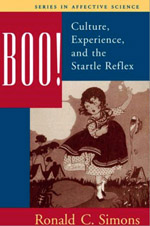
|
Malaysia and Indonesia |
afflicted person becomes flustered and may say and do things that appear amusing, such as mimicking people's words and movements |
mal ojo
(evil eye)
evil eye
-- Wikipedia
Evil Eye: A Casebook by Alan Dundes (Madison: University of Wisconsin Press, 1992)
Death by Envy: The Evil Eye and Envy in the Christian Tradition by George Aquaro (iUniverse, 2004)
The Evil Eye: The Classic Account of an Ancient Superstition (Dover Books on Anthropology and Folklore) (Vol i) by Frederick Thomas Elworthy (NY: Dover, 2004)
|
Mediterranean and Latin American Hispanic populations
(and the more general concept of "evil eye" is also found elsehere) |
fitful sleep, crying without apparent cause, diarrhea, vomiting, fever in a child or infant |
susto
(fright sickness)
susto
-- Wikipedia
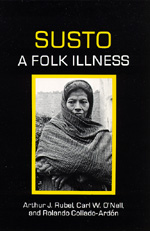
|
Latin American Hispanic populations in U.S.A., Mexico, and Central and South America |
usually associated with a broad array of symptoms, including nervousness, anorexia, insomnia, listlessness, despondency, involuntary muscle tics, and diarrhea; thought to be caused by fright that results in loss of soul from the body; causes can be natural or "supernatural" -- natural susto may occur after a near miss or accident, a supernatural susto may occur after witnessing a supernatural phenomena such as a ghost; a supernatural susto might be sent by sorcerers; those most likely to suffer from susto are culturally stressed adults--women more than men |
|
pibloktoq
(Arctic hysteria)
piblokoto
-- Wikipedia
|
Inuit of the Arctic, Siberian groups |
brooding, depressive silences, loss or disturbance of consciousness during seizure, tearing off of clothing, fleeing or wandering, rolling in snow, speaking in tongues or echoing other people's words |
windigo
wendigo
-- Wikipedia
|
Cree, Ojibwa, and related Native American groups of central and northeastern Canada |
depression, nausea, distaste for usual foods, feelings of being possessed by a cannibalistic monster, homicidal or suicidal impulses |
ghost sickness
Ghost sickness
-- Wikipedia
|
Navajo of the southwestern United States |
weakness, bad dreams, feelings of danger, confusion, feelings of futility, loss of appetite, feelings of suffocation, fainting, dizziness, hallucinations and loss of consciousness |
|
Aiyiperi |
Yoruba
(Nigeria) |
hysterical convulsive disorders, posturing and tics, psychomotor seizures |
anfechtung |
Hutterites
(Manitoba, Canada) |
withdrawal from social contact, feeling of having sinned, feeling of religious unworthiness, temptation to commit suicide |
brain fag
brain fag
-- Wikipedia
|
Nigeria and East African students |
pain, heat or burning sensations, pressure or tightness around head, blurring of vision, inability to concentrate when studying, anxiety and depression, fatigue and sleepiness |
|
koro
koro
-- Wikipedia
|
South China, Chinese and Malaysian populations in southeast Asia, Hindus of Assam |
anxiety in males that the penis will recede into the body and for females that the vulva and breasts will recede into the body |
shinkeishitsu |
Japan |
fear of meeting people, feelings of inadequacy, anxiety, obsessive-compulsive symptoms, hypochondriasis |
Adapted from Cultural Anthropology, 2nd ed. Miller, Barbara D. Boston:Allyn and Bacon, 2002, p. 156, who, in turn adapted it from Ronald C. Simons and Charles C. Hughes, eds., The Culture-Bound Syndromes: Folk Illnesses of Psychiatric and Anthropological Interest, Boston, D. Reidel, 1985: 91-110.
|