|
Spring
2019 Calendar |
|
|||||
|
||||||
Thursday, 26-Feb-2026 15:50:46 GMT |
Term Paper Extra Credit Option
s2019 The MA Extra Credit due by the end of Week 13, by Saturday, 20 April 2019.
s2019 The MA Extra Credit Term Paper Term Paper is due by the end of Week 13, by Saturday, 20 April 2019. |
Turn in your paper to your  folder
MLA Sample Papers |
for your research papers try the
for your research papers try the
UMD Library > Research Tools and Resources >
Assignment Calculator
<http://www.d.umn.edu/lib/assign/>
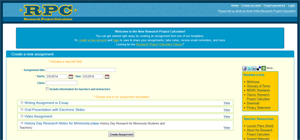
Paper is due to  assigment area

| You may earn extra credit by writing one paper supplementing any topic of this course. As this is basically an introductory course in Mesoamerican prehistory, we will cover a broad spectrum of topics in a limited manner.
If you have not had a lot of experience writing term papers, this
option provides an excellent opportunity to develop your writing skills.
It also usually results in a higher grade for the course.
This is basically an introductory course in which we will cover a broad spectrum of topics in a limited manner. Extra credit term papers allow you to cover one of those topics in a more comprehensive fashion. You may write on any topic related to this course, but your paper must reflect work and include materials not considered a normal part of this course. Extra credit Case Study papers can receive up to 100 points (about 8.3% of final grade*) -- if they
are turned in on time. A-grade papers receive up to 90 - 100 points (*percentages will vary a little bit depending on the final number of Forum topics for the term)
Follow this schedule:
Extra Credit Lecture / Film Review Option
As mentioned in the "Note on Videos and Visual Anthropology" one of the four main characteristics of American Anthropology is fieldwork, and the next best thing to hopping a bus or plane is going to places and viewing subjects by film. Although in Ancient Middle America we view a substantial number of videos, in the area of Ancient Middle America many hundreds of quality films exist--including feature films, documentaries, "shorts," interesting YouTube vignettes. For the Film Review Option choose a feature-length film or a documentary that is not assigned in class and review it, as you might for a column in your college newspaper. Recommended "Optional" and "Supplementary" videos are listed on your Moodle page "Topic Presentations" sections. This same information is also available for the semester on the "Video Schedule" page. Feature-length films and major documentaries (that qualify for Extra Credit) are listed on the "Films and Videos" page. The information on reviewing films from the Anthropology of Food Class might be helpful.
Qualifying public lectures will be announced as opportunities arise. The public lectures extra credit option could include approved lectures available on-line from Open University type lectures availble from some universities. See, for e.g. . . . Ancient Cultures of Middle America On-Line Lectures from Other Universities and Organizations
Extra credit Film/Lecture Reviews can receive up to 30 points (about 2.5 % of final grade*) -- if they
are turned in on time. A-grade papers receive up to 28 - 30 points (*percentages will vary a little bit depending on the final number of Forum topics for the term)
|
This course is governed by the . . .
University of Minnesota Duluth Student Academic Integrity Policy Use of AI-content generators for assignments in this class When I taught Advanced Writing for the Social Sciences here at UMD, for over twenty-five years, my rule of thumb advice to students was to plan to spend 60% or more of their time and effort revising drafts (for academic type writing). In 2001 Wikipedia appeared on the scene and very quickly became a useful tool as a starting point for many academic projects even though as an open-source resource the Wikipedia entries are not checked and verified in the same manner as other traditional reference materials. Spelling and grammar checkers arrived on the general scene and helped with spelling and grammar checking, but, as you no doubt have discovered, they continue to require human editing. And, of course, before that we had a selection of excellent Encyclopedia offering good starting points for many projects, the most popular being The Encyclopedia Brittanica. And long before that there were libraries--since at least the days of Alexandria in Egypt, in the third century B.C. The bottom line . . .
Today the evolution of research resources and aids continues with the relatively rapid appearance of ChatGPT and other automated content generators. As many folks have already found out, they can be very useful as starting points, much like their predecessors. But, from the academic point of view, they are still only starting points.
Professors nationwide are for the most part advised, and even encouraged, to experiment with the potentials of ChatGPT and similar apps. In this class it is fine to experiment, with the caveat that all of your written academic work demonstrates that your personal efforts—including content development and revision—reflect your personal originality, exploration, analysis, explanation, integrating and synthesizing of ideas, organizational skills, evaluation, and overall learning and critical thinking efforts. That is to say you may experiment with the AI tool to do tasks such as e.g, brainstorming, narrowing topics, writing first drafts, editing text, and the like. AI-generated works should in no case be more than that. In the end you need to become familiar enough with the various subjects, peoples, and places discussed in this class to research a topic and problem-solve on your own, and carry on an intelligent conversation about them in modern-day society . . . a conversation that goes byond your voicing an unsupported opinion. USEFUL LINKS FOR MORE INFORMATION: From Jill Jenson, Director of the Academic Writing & Learning Center For the record, what follows is the official UMD Academic Integrity Policy. Note that "unless otherwise noted by the faculty
member" this is the default policy. "UMD’s Academic Integrity policy covers any work done by automated content generators such as ChatGPT or other generative artificial intelligence tools unless otherwise noted by the faculty
member. These tools present new challenges and opportunities."
and the UMD Student Conduct Code The instructor will enforce and students are expected to follow the University's Student Conduct Code [http://www1.umn.edu/regents/policies/academic/Student_Conduct_Code.html] Instructor and Student Responsibilities Policy AVISO! Failure to comply with the above codes and standards when submitting an Extra Credit paper will result in a penalty commensurate with the lapse, up to and including an F final grade for the course, and, at a minimum, a reduction in total points no fewer than the points available for the Extra Credit project. The penalty will not simply be a zero for the project, and the incident will be reported to the UMD Academic Integrity Officer in the Office of Student and Community Standards.
A Note on "Cutting and Pasting" without the Use of Quotation Marks If you use others' words and/or works you MUST so indicate that with the use of quotation marks. Failure to use quotation marks to indicate that the materials are not of your authorship constitutes plagiarism—even if you have a citation to the source elsewhere in your paper/work. Patterned failure to so indicate that the materials are not of your own authorship will result in an F grade for the course. Other instances of improper attribution will result in a 0 (zero) for the assignment (or a reduction in points equal to the value of an Extra Credit paper), and a reduction of one grade in the final grade of the course. All incidents will be reported to the UMD Academic Integrity Officer in the Office of Student and Community Standards as is required by University Policy. |
© 1998
- 2023 Timothy G. Roufs — All rights reserved  Page URL: http:// www.d.umn.edu /cla/faculty/troufs/anth3618/maextrac.html Last Modified 30 March 2019 Site Information / Disclaimers ~ Main A-Z Index |
|
|
View Stats |
|


 Paradigm Online Writing Assistant at <
 for information on how to cite
items from the web.
for information on how to cite
items from the web.