- "Fruit-Full" Arkansas: Apples -- Crystal Bridges Museum of American Art and the University of Arkansas
- Great Moments in Apple History [timetable] -- Mitch Lynd, Midwest Apple Improvement Association
- Janik, Erika. Apple: A Global History. London: Reaktion, 2011.
- Lawrence, Felicity. Eat Your Heart Out: Why the Food Business is Bad for the Planet and Your Health. London: Penguin Books, 2008.
- Lawrence, Felicity. Not on the Label: What Really Goes into The Food on Your Plate, Revised Edition. London: Penguin Books, 2013.
- Minnesota Harvest > Picking Dates
- National Apple Museum
- Picking Schedule, Minnesota -- Minnesota Harvest
- Robinson, Jo. Eating on the Wild Side: The Missing Link to Optimum Health. NY: Little, Brown and Company, 2014.
- Timmerman, Kelsey. Where Am I Eating?: An Adventure Through the Global Food Economy with Discussion Questions and a Guide to Going "Glocal". Hoboken, NJ: Wiley, 2014.
- Toussaint-Samat, Maguelonne. A History of Food. Chichester, UK: John Wiley & Sons/Blackwell 2009.
- Tree Fruit Research & Extension Center -- Washing State University
Browning, Frank. Apples: The Story of the Fruit of Temptation. NY: North Point, 2000.
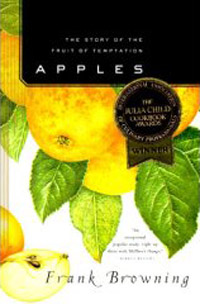
(ISBN-10: 0865475792)
(ISBN-13: 978-0865475793))
From Publishers Weekly
"In what he describes as 'a quirky piece of personal and agricultural storytelling,' Browning contemplates aspects of the 'forbidden fruit,' from its probable origins in the mountains of Kazakhstan to its modern transformation into a high-tech product of commercial orchards. In his quest for knowledge about the apple, he talks to collectors of old varieties, commercial monoculturists, genetic engineers and master cider-makers. He travels to Kazakhstan to meet a scientist who devotes his life to the preservation of the world's original apple forests; to Geneva, N.Y., to visit Cornell University's apple-breeding program; and to France, England and the western hills of Virginia to taste traditional ciders. Although he is unenthusiastic about the perfectly shaped but bland Golden Delicious, Jonathans, Red Delicious, Granny Smiths and Fujis found in supermarkets today, he realizes that the tastier heirloom varieties such as Westfield Seek-No-Further, Newton Pippin, Winter Pearmain and Roxbury Russet are not commercially viable. Accepting the apple as a 'full partner in the age of science and modernism,' he's optimistic that breeders, perhaps by crossing apples from the primeval forests of Kazakhstan with other varieties, will create new apples that are flavorful as well as long-keeping, hardy and disease-resistant. A chapter on the apple in mythology and religion is a bit superficial, but for the most part, Browning, who owns an apple orchard in Kentucky, is informative and entertaining, though his story lacks the overarching historical context or the narrative drive of a book like Mark Kurlansky's Cod. Appendices include descriptions of 20 'prize' apples, new and old; a brief discussion of rootstocks and tree sizes, for backyard orchardists; and a sampling of apple and cider recipes from around the world. -- PW.
Copyright 1998 Reed Business Information, Inc.
From Library Journal
"Apple grower and journalist Browning explores all aspects of the popular fruit. First he travels to the apple forests of Kazakhstan, where apples probably originated, to visit a scientist who studies and preserves these ancient forests; then he relates world myths, legends, and the apple's significance in religion. Browning next details the high-tech world of apple genetics at the USDA's apple germ-plasm repository and apple-breeding techniques at Cornell's breeding facility in Geneva, NY. Finally, he writes about the businesses of apple growing and cider making. Woven throughout are accounts of Browning's experiences growing up on an apple orchard and his life as an orchardist. Appendixes include the best cooking and eating apples, brief backyard orchard information, and a few apple recipes. While Browning presents more details about apples than the average reader may care to know, his book would be a nice resource for students doing a report on apples or who need a collection of interesting apple facts. Recommended for public libraries and academic agricultural collections." -- Sue O'Brien.
Copyright 1998 Reed Business Information, Inc.
|
|