This page will serve as the home base for our class this semester.
I will update this page for each class meeting. Items that appeared on this page from previous meetings can be found via the "<previous Blackboard items>" link at the bottom of this page.
The menu on the left will give you access to other materials related to the course.
Introductions and Roll.
Syllabus. On the first day, we'll be looking carefully at the syllabus.
Tour this site
For Thursday, please obtain a USB drive (a.k.a., jump drive, thumb drive, key-chain drive), and create a structure of folders that looks like this. You don't need to buy a new drive if you already have one with at least 100 MG of space on it. You can also use a Zip disk, though these are less durable:
You will create and turn in a draft or "BETA" version of the PCHP Project, and, a week later, a Final Version. See the schedule for dates.
Round Characters
Make a list of "round" characters you can think of from movies, television, books, etc. How do these characters incorporate different, sometimes even contradictory traits?
Save it as “pchp brainstorm” in your “nonwww” folder in a new folder called “pchp” (nonwww/pchp). (If you don't have a USB drive or disk, save this in "My Files" on your desktop for now and move it to your drive next time)
Type the number “1” at the top
Below it, type a list of at least 12 places, things, activities, goals, experiences, social scenes, tastes, etc. that are part of your experience and how you identify yourself.
Blackboard for 1/18 (Thursday Week 1)
Seating
Please try to sit where you did on the first day. This will help me learn your names this semester.
As a way of measuring the effectiveness of this class, please answer a few multiple choice quesitons about your experience and confidence (here at the beginning of the semester) with various technical and conceptual areas. Your responses here will not effect your grade in any way.
For Tuesday, complete the PCHP Brainstorming Session that we'll begin today in class. Bring in a paragraph (Step 5) printed out and the complete "session" (Steps 1-5) on your disk.
Disk/Drive and folders. Any trouble getting your Disks/Drives and creating a set of folders that look like this?
Logging Out
When you leave today, don't forget to log out of your computer workstation. Double-click the "Logout" icon on the desktop.
Brainstorming. Today, we'll begin a Brainstorming Session for the PCHP following a handout I'll give you in class. Complete this session for next time, and bring in the complete session document on disk. Also bring in the final paragraph printed out.
Liquid Page Design (10:10)
Comment: Liquid Page Design is ideal for pages that contain lots of text because text flows to fill whatever space is available. The page you are looking at now has a "liquid" design. If you resize the width of the page, notice how the content contracts or expands to fill the whatever space you give it. Such a design makes good use of "screen real estate": little empty space is trapped at the top (where the real estate is more valuable) and scrolling is kept to a minimum.
Today, we'll try out Dreamweaver by making a Web page, posting it to the Web, and then visiting that page with our Web browser.
If we get far enough into these exercises today in class, I will ask you to complete these two exercises by class time on Wednesday. Send the URL to me in an e-mail with the subject line "5230-01 exercise jan 19 "
If we don't get into these exercises sufficiently, we will complete these in class on Tuesday and use the Webx discussion board to post the URLs.
In the "Liquid Page" exercise, I'll ask you to collect some online content from a Web site you like which uses both words and images. I'll use the blog "BoingBoing," which you're welcome to use too if you can't think of something else.
Blackboard for 1/23 (Tuesday, Week 2)
Seating
Please try to sit where you did on the first week. This will help me learn your names this semester.
"round-character" presentation (vs. flat or diffuse)
setting up a "site" in Dreamweaver (exporting & importing site information in a .ste file)
liquid page design
clustering (as a brainstorming technique)
freewriting (as a brainstorming technique)
For Thursday:
1. At the end of class today, I'll announce which exercises you'll be responsible for completing and posting to the Web by Wednesday at 2 p.m., and which exercises we might complete together on Thursday
2. For those exercises that are due by tomorrow at class time, I'll also ask you to log into the Webx Discussion Board by that same time and send the URL(s) of the exercise(s) in a message to the appropriate discussion(s):
Turning in your Trial Preamble (Step 5 PCHP Brainstorming)
I will to collect the paragraphs you wrote as a result of the Brainstorming Session I asked you to complete for today.
I understand that these paragraphs, at this point, are trials and explorations. I just want to see what you're thinking about at this early stage of the assignment.
Importing Your Site Information
If you "Exported" your site information from Dreamweaver to your disk last time (as a file called "www.ste") import that file back into Dreamweaver before we begin. Choose Site > Manage Sites and then click the Import button. See page 469 in your Dreamweaver book for directions.
Xcopy
Last Thursday in class, I mentioned a program that comes in Windows XP called Xcopy for automatically and quickly backing up files. See the explanation of Xcopy on the Resources page if you're interested.
When You Leave
When you leave today, don't forget to
save all your files to your drive/disk
take your drive/disk
log out of your computer workstation (double-click the "Logout" icon on the desktop)
1. Revise your concept/preamble to improve it, based on some of the principles and responses we'll talk about today. Bring in a printed copy to turn in.
In the preamble, list-like chains of topics don't lend much unity, even when the items are glued together with generic transitions like "When I'm not doing X, I like to..." or "For a break, I like to..." If the topics can't be pulled together in the preamble, they're probably not going to seem unified on the Web page. If you mention something only once, maybe you should drop it altogether.
Instead of lists or chains of topics, use an "umbrella idea" or scene to bring things together. In your draft, look for a "center of gravity"—some line or moment when the writing found itself and made something happen. Start with that in your next draft.
The first line is vital. Don't start with ritual throat-clearing and general information. Look at your writing and, in a revision, try starting with the best line.
The shorter the better. Condense, distill, combine sentences, suggest rather than explain, let the part imply the whole. I've never used this version of my home page because I think the preamble is still too long.
The more concrete and specific the better. Rather than "I like movies," say "My favorite movie of all time is Major League (or Pulp Fiction, or Shrek...." See how it makes a difference?). If the time you spent in Denmark is important, share some tidbit or micro-memory that helps make that time and place real to us....
If we complete this exercise (or if I assign it to be posted by tomorrow at class time), copy and paste the URL in a message to the Webx discussion banner URLs.
Complete the Jello Page Design exercise, post it to the Web, and send the URL to the Webx discussion "jello URLs."
For Thursday
Bring in all materials (especially images) to work on your PCHP project. You'll want to find elements to include that recall and fulfill topics you introduce in your preamble (see "How the Preamble Helps..." below).
How the Premable Helps You to Make Design Decisions For the Whole Page or Site
The preamble is not just a part of your Personal Course Home Page. It also contains, like DNA, the essential plan for the page's whole design scheme.
Read again my attempt at a preamble (still too long!) on this mock-up of my home page, and then try to pick out features and elements elsewhere on the page that recall topics from the preamble.
Choose two logos to contrast, download them to your non-www folder, open both in Photoshop.
Download and open in Photoshop this version of the color wheel.
Open Photoshop's color picker (click the foreground color tile at the bottom of the Tool Palette) and then "pick" the various colors in the logo.
Decide which logo you want to talk about mostly (your primary example), and which one you merely want to use for contrast and comparison (the foil).
In a message to the Webx discussion "color," type in the name of the two logos in the first line (starting with your primary example).
Starting on the second line of the message, discuss one logo's use of color in the following six ways, mentioning the second logo to compare or contrast. Comment on the use (or not) of all of the following, specifically using these terms. Start with what you think is most surprising or revealing about the logo's use of color:
"hue" (especially what the color picker shows you about any deviations from pure "primary" colors)
dimension
use of "complementary color contrasts" (or the degree that the contrasts are "bent" or not used at all)
use of "warm" and "cool" colors (in contrast or not)
When we complete this exercise (or if I assign it to be posted by tomorrow at class time), copy and paste the URL in a message to the Webx discussion banner URLs.
When we are finished, you'll post this exercise's folder (www/5230/exercises/jello) to the Web, visits the page with your browser, and copy the URL into the Webx discussion "jello URLs."
Personal Course Home Page Project (BETA) Due by Monday, February 5 at noon
To turn in the PCHP Project (BETA) by the deadline:
Create your PCHP project on your disk in the folder www/5230/personal. Be sure to keep all images in the folder www/5230/personal/assets. Save the page as "index.html" so it will function as the default page.
Post all the contents of your "personal" folder to the folder www/5230/personal on the server.
Visit the page with your browser and copy the URL from the location bar
Go to the Webx discussion "Personal Course Home Page URLs," click "Post Message," paste the URL into the message box, and post it by the deadline.
Note: there is no commentary required for the BETA version due Monday. You will write a commentary on the finalversion (Monday 2/12) and turn it in at the beginning of class on Tuesday 2/13.
For Next Tuesday
Read Jakob Nielsen's
Chapter 1, "Why Web Usability?" (page 8), and
Chapter 2 "Page Design" (page 16).
Reading Guide for Nielsen's Chapters 1 and 2
As you read, consider some of the following questions that we'll talk about in class on Tuesday.
Nielsen says he's "an evangelist at heart" when it comes to usability design. Who's he arguing so passionately against?
In creating the BETA version of the PCHP project, what "errors" did you commit, according to Nielsen? Are there useful principles and techniques you wish you had known?
What's the big deal about "screen real estate"?
How do we make effective use of screen real estate?
A link can be ineffective, according to Nielsen, even if it works when you click it. How so?
What's the most surprising fact, opinion, or piece of advice that Nielsen offers in these readings, in your opinion?
Import Your Site Information Into Dreamweaver.
SeaMonkey
If you would like to work on your Web-based projects at home (and don't want to download the 30-day trail version of Dreamweaver until April 10), you can download and use Mozilla's SeaMonkey Suite, which include's a free HTML editor, Composer
Like Dreamweaver, SeaMonkey's Composer is a "WYSIWYG" editor ("What You See Is What You Get") that writes and revises HTML code. Since HTML is not a proprietary language (requiring corporate-specific software to read), you should be able to move between Dreamweaver and Composer with few problems. Let me know if you do have problems.
I will keep a permanent link to the SeaMonkey Suite's download page on the Resources page.
When we are finished, you'll post this exercise's folder (www/5230/exercises/jello) to the Web, visits the page with your browser, and copy the URL into the Webx discussion "jello URLs."
Studio Day
Though we will be working individually for the rest of today, please plan on staying and being productive till the end of class.
Personal Course Home Page Project (Final) Due by Monday, February 12 at noon
To turn in the PCHP Project (Final) by the deadline:
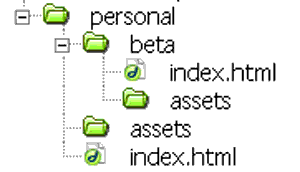
Copy all the folders and files of your BETA version to a folder www/5230/personal/beta. See directions below in "Archiving the BETA Version"
Revise your PCHP project on your disk in the folder www/5230/personal. Be sure to keep all images in the folder www/5230/personal/assets. Save the main page as "index.html" so it will function as the default page.
Be sure that you not only change the "index.html" in the "personal" folder, but upload that changed version of the page to the Web. You can revise and upload as many times as you want. The Web is just another disk to back up on.
Visit the revised page with your browser to check that all is working.
Do not repost the URL to the Webx discussion unless the URL has changed. If you do need to change the URL, post the new one in a "reply" to your original message to "Personal Course Home Page URLs" so both messages will appear together.
Write a commentaryon the finalversion, print it out, and turn it in at the beginning of class on Tuesday 2/13.
Archiving the BETA Version
You should archive the BETA version (save it in a sub-folder called "beta" inside of "personal") so you can preserve the original while you're updating the page for the final version:
Import your site information ("www.ste" file) into Dreamweaver.
In the Files Palette of DW, right-click on the "personal" folder, and choose Edit > Duplicate
Change the name of the new folder from "Copy of personal" to "beta"
Open the "personal" folder
Drag the "beta" folder into the "personal" folder (top level). When prompted, choose to "Update Links"
Check in your Files Palette to see if you now have an arrangement like this:
Close the "beta" folder and forget it. Make all future changes to the "index.html" page at the top level of "personal," which will become your PCHP Final.
Post the "beta" folder to the Web (click the "beta" folder to select it in Dreamweaver's Files Palette, and then click the up-arrow icon at the top of the Files Palette.)
Check that the archived BETA version is online. In your browser, enter the URL for your PCHP (you could also click the link in Webx discussion "Personal Course Home Page URLs") and add "/beta/" at the end, as in "...5230/personal/beta/"
Today we'll discuss what we've learned from Jakob Nielsen's chapters that we can use in revising the PCHP, during the rest of the semester, and beyond.
Reading Guide I gave you last Thursday
As you read, consider some of the following questions that we'll talk about in class on Tuesday.
Nielsen says he's "an evangelist at heart" when it comes to usability design. Who's he arguing so passionately against?
In creating the BETA version of the PCHP project, what "errors" did you commit, according to Nielsen? Are there useful principles and techniques you wish you had known?
What's the big deal about "screen real estate"?
How do we make effective use of screen real estate?
A link can be ineffective, according to Nielsen, even if it works when you click it. How so?
What's the most surprising fact, opinion, or piece of advice that Nielsen offers in these readings, in your opinion?
Personal Course Home Page Project (Final) Due by Monday, February 12 at noon
To turn in the PCHP Project (Final) by the deadline:
Be sure you have made of copy of all the folders and files of your BETA version to a folder www/5230/personal/beta. This will be the "before" version to your final PCHP's "after."
Revise your PCHP project on your disk in the folder www/5230/personal. Be sure to keep all images in the folder www/5230/personal/assets. Save the main page as "index.html" so it will function as the default page.
Be sure that you not only change the "index.html" in the "personal" folder, but upload that changed version of the page to the Web. You can revise and upload as many times as you want. The Web is just another disk to back up on.
Visit the revised page with your browser to check that all is working.
Do not repost the URL to the Webx discussion unless the URL has changed. If you do need to change the URL, post the new one in a "reply" to your original message to "Personal Course Home Page URLs" so both messages will appear together.
Write a commentaryon the finalversion, print it out, and turn it in at the beginning of class on Tuesday 2/13.
Commentary on the PCHP Due at the Beginning of Class on Tuesday, February 13 at noon
See the directions for writing the commentary from the syllabus.
Though you'll be working individually today, plan on staying the entire class period, the same as any other class meeting.
Additional Skills
While we won't take time in class to try them out together, you might find following skills from the Dreamweaver book helpful in working on your Personal Course Home Page.
Making "Relative" Links (winthin your site) by "Pointing to a File," page 66-67
Making "Absolute" Links (to a page outside of your site), page 66-67
Image Links, page 217
Linking to an Email Address, page 218
Making Text Headings, page 90
Changing Fonts and Font Size, page 94
Changing Font Color, page 97
Using Text Styles, page 98
Breaking Lines Without Adding a Blank Line, page 101
Formatting Lists, page 107-108
Checking Your Spelling, page 129
Quick Uploading of the Current Page (if you have your site set up in Dreamweaver): Save the page, Look in the tool bar immediately above the page window, Click the down/up arrow button, Choose the "Put" command.
Quick Uploading of a Whole Folder from the Files Palette, page 50-51.
Starting next Tuesday and for the next three class periods, we will workshop the PCHP Projects one at a time in class.
Before class, please do the following:
Review the workshopping page for ideas about what to discuss in your comments.
Visit the Personal Course Home Page projects scheduled the class meeting in the schedule below. Before class on workshop day,
Typeand printout written comments and suggestions for each project scheduled for that day. Bring both the printout of your comments and the digital file to class for copying and pasting (explained below).
Before class starts, copy and pasteall the written comments you've made for everyone scheduled for that day into the form "Workshop Comments for Today" and click "Send to Craig." Be sure to label each set of comments with the project number, the name of the project's author, and the correct date of the workshop.
Individually send each author your comments on his or her project by using the e-mail list on the form "Workshop Comments for Today.
Glocalization Brainstorming due Next Tuesday, 2/20
Introducing the Next Project
Take a look at the assignment page for Glocalization Site Project.
Brainstorming Due by Next Tuesday
I will give you an brainstorming handout, which I will expect you to complete by next Tuesday.
Post the "glocalbrainstorming.doc" file to your "glocal folder." Then try visiting the .doc file with your browser.
You won't be able to open the file with your browser (it will ask you if you want to open it with Word or download it).
But you can...
right-click the link to the file from the "index" page and
choose to "Copy Link Location" (Firefox).
Paste the URL into a message to the Webx discussion "glocal brainstorm URLs" and post it.
Marking Up Text
We will learn a little bit about what's happening behind the scenes with HTML code. This can help us understand what Jakob Nielsen means when he says we should "separate meaning and presentation."
Send the URL of the final project, posted to the Web, in a message to the Webx discussion "code URLs."
Tiling Backgrounds
We'll learn to create our own tiling backgrounds in this exercise. See the "Tiling Backgrounds" page from the Techniques Site where you will download an image to use.
Send the URL of the final project, posted to the Web, in a message to the Webx discussion "tiling URLs."
Class Blackboard for Tuesday 2/20
(Week 6)
Roll
Questions?
Questions on the Glocalization Project?
Glocalization Brainstorming due Today
By the beginning of class today, please post the "glocalbrainstorming.doc" file you created in the brainstorming session to your "glocal folder."
Then try visiting the .doc file with your browser. You won't be able to open the file directly with your browser (it will ask you if you want to open it with Word or download it).
But you can...
right-click the link to the file from the "index" page and
choose to "Copy Link Location" (in Firefox).
Paste the URL into a message to the Webx discussion "glocal brainstorm URLs" and post it.
Workshop Today, Thursday and Next Tuesday
Starting today, we will workshop the PCHP Projects one at a time in class.
Before each day's class meeting , please do the following:
Review the workshopping page for ideas about what to discuss in your comments.
Visit the Personal Course Home Page projects scheduled the class meeting in the schedule below. Before class on workshop day,
Typeand printout written comments and suggestions for each project scheduled for that day. Bring both the printout of your comments and the digital file to class for copying and pasting (explained below).
Before class starts, copy and pasteall the written comments you've made for everyone scheduled for that day into the form "Workshop Comments for Today" and click "Send to Craig." Be sure to label each set of comments with the project number, the name of the project's author, and the correct date of the workshop.
We will continue workshopping the PCHP Projects one at a time
in class.
Before each day's class meeting , please
do the following:
Review the workshopping
page for ideas about what to discuss in your comments.
Visit the Personal Course Home Page projects
scheduled the class meeting in the schedule below. Before class
on workshop day,
Typeand printout written comments
and suggestions for each project scheduled for that day. Bring
both the printout of your comments and the digital file to class
for copying and pasting (explained below).
Before class starts, copy and pasteall
the written comments you've made for everyone
scheduled for that day into the form "Workshop
Comments for Today" and click "Send to Craig." Be
sure to label each set of comments with the project number, the
name of the project's author, and the correct date of the workshop.
Please read Jakob Nielsen's Chapter 3 and complete the Reading Guide.
Questions on the Glocalization Project?
Workshop Today
We will continue workshopping the PCHP Projects one at a time
in class.
Before each day's class meeting , please
do the following:
Review the workshopping
page for ideas about what to discuss in your comments.
Visit the Personal Course Home Page projects
scheduled the class meeting in the schedule below. Before class
on workshop day,
Typeand printout written comments
and suggestions for each project scheduled for that day. Bring
both the printout of your comments and the digital file to class
for copying and pasting (explained below).
Before class starts, copy and pasteall
the written comments you've made for everyone
scheduled for that day into the form "Workshop
Comments for Today" and click "Send to Craig." Be
sure to label each set of comments with the project number, the
name of the project's author, and the correct date of the workshop.
Please read Jakob Nielsen's Chapter 3 and complete the Reading
Guide. (Note that you can either open the reading guide and fill it out on your computer to print out, or print it out and fill it in by hand. I will ask for hardcopies of this document, rather than electronic copies.)
Questions on the Glocalization Project?
Workshop Today
We will continue workshopping the PCHP Projects one at a time in class.
Before each day's class meeting , please do the following:
Review the workshopping page for ideas about what to discuss in your comments.
Visit the Personal Course Home Page projects scheduled the class meeting in the schedule below. Before class on workshop day,
Typeand printout written comments and suggestions for each project scheduled for that day. Bring both the printout of your comments and the digital file to class for copying and pasting (explained below).
Before class starts, copy and pasteall the written comments you've made for everyone scheduled for that day into the form "Workshop Comments for Today" and click "Send to Craig." Be sure to label each set of comments with the project number, the name of the project's author, and the correct date of the workshop.
Bring in (written down) a new, improved topic/angle for your Glocalizaiton Project along with a list of possible "structual" menu items to organize the site.
Turn in Reading Guide Handouts for Nielsen's Chapter 3
Inventing a Glocal Angle on a Local Topic (Brainstorming)
Copy the following list of topics/angles into a blank page in Word.
Above the list, insert a 3-column/1-row table
At the top of the left-hand column, type the heading "Truly Glocal"
At the top of the middle column, type "Local Only"
At the top of the right-hand column, type "Not Local"
Now, imagine you are someone living in Phoenix, Arizona (or wherever) who will never leave Phoenix except via the Web , visiting a Web site created around each of these topics/angles.
Copy and paste the site topics/angles that you might find compelling, interesting, and relevant to you in the "Truly Glocal" column.
Copy and pastethe site topics/angles that you would not find compelling, interesting, and relevant to you in the "Local Only" column.
Copy and pastethe site topics/angles into "Not Local" that could interest you in a general way but not take you on a virtual visit to some locale (Duluth, Beaners, etc.).
Reconsider your choices, especially in the "Only" and "Not" columns. If you shared a certain interest, taste, passion, enthusiasm with the creator of the site, could you imagine moving any topics/angles to the "Truly Glocal" column.
(In parentheses, type in what that special interest, taste, passions, enthusiasm would need to be for that item to stay in the "Truly Glocal" column.)
What if you changed the wording of the item to re-focus the angle, or took just one of several possible angles. (Indicate such changed items on your list with bold.)
* North Shore State Parks: As winter sanctuaries; As fall color showcases; As a scientific and natural experience; As family vacation sites; As a walk in the woods; As sidekicks to Lake Superior; As an escape from the city
* The Lakewalk: History; Directions; Things to do; Facts; Home; Pictures; Places to go; Things to see
* Bridge
* Mall
* Arrowhead Road
* Skyline Parkway is a road in Duluth with many scenic overlooks of the city of Duluth along with Enger Tower. I was thinking of doing a website telling of all the sights along this road. Maybe giving tips on what to see while driving, biking, or running along this road. If I can I might be able to get a history of the road.
* Basement Parties are a fad among the youth of Duluth, but I have yet to figure out why. There is no head room, (especially for me since I’m 6 foot), the floor is sopping wet, and the smell is repulsive. I have yet to find the joy of being compacted into a cramped, smelly place, rubbing up against sweaty individuals who are guaranteed to spill their beer on you.
* The Glesheen Mansion is a very hot tourist attraction in Duluth. The 39-room mansion was built by the Congdon family. The infamous murder of Heiress Elizabeth Congdon and her nurse, who were bludgeoned and smothered to death in 1977, have created a whirlwind of myths about the mansion being haunted.
* Lutsen Mountain: The only actual Mountain in the Midwest. As an tourist attraction; As minnesota’s window to the rest of the world; As the outdoors; As a get away; As a great way of life
* Living at the top of a hill: As calmness precedes; As the view from the top; As the view of the lake; As the greenery surrounding it; As the sun setting down; As the sun setting up; As the birds that flew by; As the wind going strong; As the winter getting colder and being besides the fire place; As all white in snow; As the colorful leaves the would emerge before the snow; As the leaves that comes back by the spring
* 4-H building at the MN State Fair: As a place in Minnesota; As a tornado-proof building; As a place for friendship; As a leadership experience; As a rite of passage; As social relations; As the face of Minnesota 4-H; As a stage; As a competitive grounds; As the beginning of romance; As a house of memories; As a dance floor
* Hermantown and how is it separate from Duluth: As commerce; As a school system; As services; As stuff to do; As proximity to other Northern Minnesota locations; As informative to someone not from the area (or in this case, this planet…)
* Boundary Waters: -As a fishing area -As a relaxation getaway -As a camping area -As a hiking area -As an adventurous place to visit -As a good time with friends -As a place to go by yourself or very few friends -As a place to see many different nature scenes
* Hartley Park in Duluth: Wildlife; Photography; Trails; Special Locations
* Grandma’s Sports Garden: A website showing the experience of Grandma’s Sports Garden in Canal Park--As a Saturday night hangout for UMD students; As a local bar scene; As a dance club; As a mixture of all ages, races, and sexes; As a sports haven; As a restaurant; As an excellent place to people watch; As a place to unwindAs place to let loose.
* The Iron Range: As a place in northern Minnesota; As a place for immigrants to start a family; As a mass provider of iron; As a cold place; As a rough terrain; As a place of factories; As place full of iron ore; As a place of pits; As a place of old-time hockey; As a Scandinavian melting pot
For this exercise, you'll need to visit the techniques page and follow directions there. I will give you a copy of the handout.
Post this exercise to a folder called "textimage" in your folder "www/5230/exercises". Visit the page with your browser and copy-and-paste the URL into a message to the Webx discussion "image into type."
Note that, once you create this file, you can
change the "background" image by replacing/hiding the image layer and hitting control+g again
you can retype the text to make multiple headings from the same file.
Every time you "Save for the Web," you take a snapshot of how this file looks at that moment.
Class Blackboard for Tuesday 3/6
(Week 8)
Roll
Questions?
For Thursday
Bring in all materials for working on the Glocalization Project in a Studio Session.
This will be the last class meeting before spring break and the Glocalizaiton Project due date on Monday, March 19.
1. From the chapter, choose one principle, technique, or piece of advice which you think is useful, interesting, or questionable.
2. Find on the web a relevant example of a page or site on the Web: that is, one that follows Nielsen's advice (successfully or unsuccessfully), one that ignores Nielsen's idea (either successfully or unsuccessfully), or that calls into question what Nielsen is saying.
In the first line, type a subject line that describes the advice
In the first line, type the page number
On the second line of the message, paste in the URL of the page you chose
4. Starting on the third line, write a brief analysis of how the example you chose fulfills or ignores Neilsen's advice, either to the benefit or detriment of the final product. If the example brings Nielsen's advice into question, explain how. In such a case, is Nielsen wrong? half right? usually right just not in this case?
For this exercise, you'll need to visit the techniques page for the "Image into Type" exercise and download the "cadmt.jpg" image to your non-www folder. Open it in Photoshop. I will give you a copy of the handout.
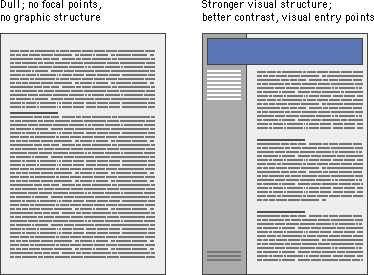
2. Headings: Image into Type (Visual Hierarchy)
For this exercise, you'll need to visit the techniques page and follow directions there. I will give you a copy of the handout.
Post this exercise to a folder called "textimage" in your folder "www/5230/exercises". Visit the page with your browser and copy-and-paste the URL into a message to the Webx discussion "image into type."
Note that, once you create this file, you can
change the "background" image by replacing/hiding the image layer and hitting control+g again
you can retype the text to make multiple headings from the same file.
Every time you "Save for the Web," you take a snapshot of how this file looks at that moment.
Class Blackboard for Thursday 3/8
(Week 8)
Roll
Questions?
Glocalization Projects due by Monday, March 19, noon.
Send the URL of the home page to the project to the Webx discussion, "glocal URLs."
The following computer labs will be open M-F during Spring Break:
SBE 14 (8 a.m. to 5 p.m.)
KPL 143 (8 a.m. to 5 p.m.)
Call the Help Desk at -8847 for more information.
For Tuesday, March 20: Commentary
Bring in a printed commentary on your own Glocalization Project to turn in.
For Tuesday, March 20: Prepare for Workshop
Review the workshopping page for ideas about what to discuss in your comments.
Visit the Personal Course Home Page projects scheduled the class meeting in the schedule below. Before class on workshop day,
Typeand printout written comments and suggestions for each project scheduled for that day. Bring both the printout of your comments and the digital file to class for copying and pasting (explained below).
Before class starts, copy and pasteall the written comments you've made for everyone scheduled for that day into the form "Workshop Comments for Today" and click "Send to Craig." Be sure to label each set of comments with the project number, the name of the project's author, and the correct date of the workshop.
Write and send your comments on the projects scheduled for workshop starting on Tuesday.
For this exercise, you'll need to visit the techniques page for the "Image into Type" exercise and download the "cadmt.jpg" image to your non-www folder. Open it in Photoshop. I will give you a copy of the handout.
2. Headings: Image into Type (Visual Hierarchy)
For this exercise, you'll need to visit the techniques page and follow directions there. I will give you a copy of the handout.
Post this exercise to a folder called "textimage" in your folder "www/5230/exercises". Visit the page with your browser and copy-and-paste the URL into a message to the Webx discussion "image into type."
Note that, once you create this file, you can
change the "background" image by replacing/hiding the image layer and hitting control+g again
you can retype the text to make multiple headings from the same file.
Every time you "Save for the Web," you take a snapshot of how this file looks at that moment.
Class Blackboard for Tuesday 3/20
(Week 10)
Roll
Questions?
Turn in Glocalization Commentary
For Thursday, March 22: Prepare for Workshop
Review the workshopping page for ideas about what to discuss in your comments.
Visit the Personal Course Home Page projects scheduled the class meeting in the schedule below. Before class on workshop day,
Typeand printout written comments and suggestions for each project scheduled for that day. Bring both the printout of your comments and the digital file to class for copying and pasting (explained below).
Before class starts, copy and pasteall the written comments you've made for everyone scheduled for that day into the form "Workshop Comments for Today" and click "Send to Craig." Be sure to label each set of comments with the project number, the name of the project's author, and the correct date of the workshop.
Write and send your comments on the projects scheduled for workshop.
illustration (1, 2, 3) vs. hybrid literacy (1, 2, 3, 4): the ability to communicate through the combination of verbal and visual languages, whereby the hybrid text means more than the words or images do in themselves.
non-linear argument
voice: a text's style suggesting the author's intentions, apparent personality, and implied audience, expressed in choices of words, language structures, images, colors, backgrounds, layouts, and other design elements. (1)
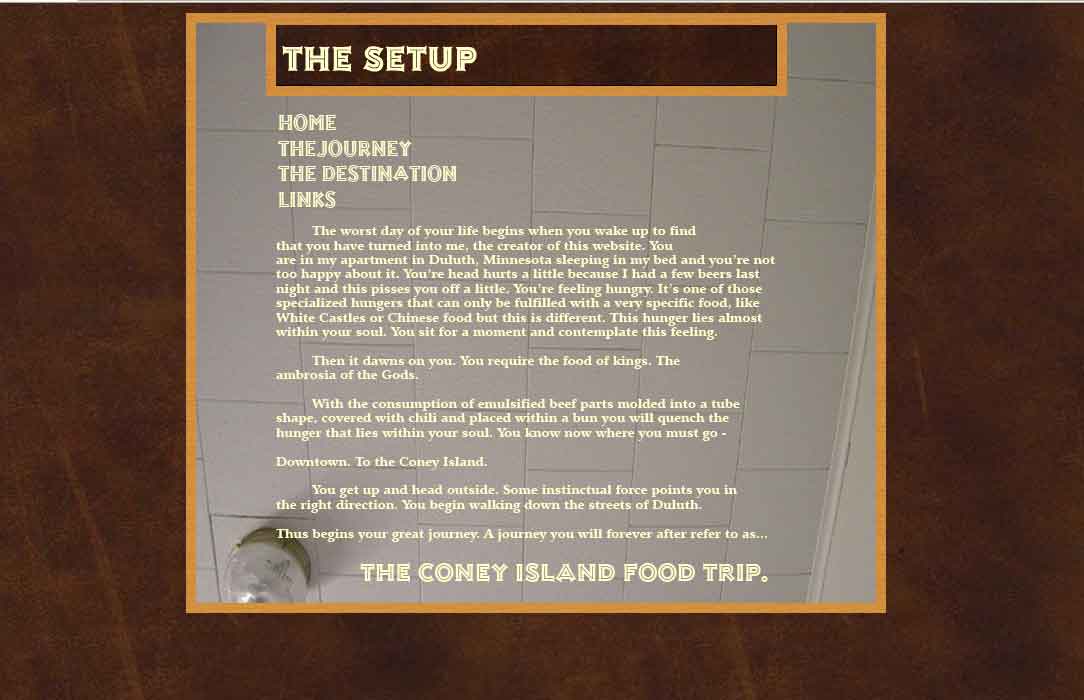
See Tabasco's history tent web site for another example of visual hierarchy
Class Blackboard for Thursday 3/22
(Week 10)
Roll
Questions?
For Tuesday, March 27: Prepare for Workshop
Review the workshopping page for ideas about what to discuss in your comments.
Visit the Personal Course Home Page projects scheduled the class meeting in the schedule below. Before class on workshop day,
Typeand printout written comments and suggestions for each project scheduled for that day. Bring both the printout of your comments and the digital file to class for copying and pasting (explained below).
Before class starts, copy and pasteall the written comments you've made for everyone scheduled for that day into the form "Workshop Comments for Today" and click "Send to Craig." Be sure to label each set of comments with the project number, the name of the project's author, and the correct date of the workshop.
Write and send your comments on the projects scheduled for workshop.
illustration (1, 2, 3) vs. hybrid literacy (1, 2, 3, 4): the ability to communicate through the combination of verbal and visual languages, whereby the hybrid text means more than the words or images do in themselves.
Bill Keaggy's Bookmarks site and "Sad Chairs" site (audience/trash and treasure)
non-linear argument
voice: a text's style suggesting the author's intentions, apparent personality, and implied audience, expressed in choices of words, language structures, images, colors, backgrounds, layouts, and other design elements. (1)
See Tabasco's history tent web site for another example of visual hierarchy
Class Blackboard for Tuesday 3/27
(Week 11)
Roll
Questions?
Before Class Today
Visit the Personal Course Home Page projects scheduled the class meeting in the schedule below. Before class on workshop day,
Typeand printout written comments and suggestions for each project scheduled for that day. Bring both the printout of your comments and the digital file to class for copying and pasting (explained below).
Before class starts, copy and pasteall the written comments you've made for everyone scheduled for that day into the form "Workshop Comments for Today" and click "Send to Craig." Be sure to label each set of comments with the project number, the name of the project's author, and the correct date of the workshop.
Write and send your comments on the projects scheduled for workshop.
Within 24 hours after the workshop, e-mail your comments to the authors of the site's discussed via their postings to the Webx discussion "glocal URLs."
illustration (1, 2, 3) vs. hybrid literacy (1, 2, 3, 4): the ability to communicate through the combination of verbal and visual languages, whereby the hybrid text means more than the words or images do in themselves.
Bill Keaggy's Bookmarks site and "Sad Chairs" site (audience/trash and treasure)
non-linear argument
voice: a text's style suggesting the author's intentions, apparent personality, and implied audience, expressed in choices of words, language structures, images, colors, backgrounds, layouts, and other design elements. (1)
See Tabasco's history tent web site for another example of visual hierarchy
Class Blackboard for Thursday 3/29
(Week 11)
Roll
Questions?
For Tuesday
Bring in an idea for your Client Project.
Please read the handout "3 out of 4 Visitors..." for discussion next time.
Brainstorming
1. Make three lists of five words/phrases each:
five desired actions that the audience could take which promote the interests of your client (either on the site, or in the world beyond),
five words that describe the ethos (the projected image, style, or public personality) of your client—what makes your client different
five words that describe the pathos (the audience's achieved sense of self or identity) created by being associated with your client.
2. Take a key word from any list—something that you see as important or key—and cluster on that word. You can use other words or phrases from your lists but also add new ones as you think of them.
3. When I tell you to stop clustering, write a sentence or phrase at the bottom of the page (or on the back) which sums up something you want to remember from this exercise: something you want to include on the site, some insight into your client's appeal, some aspect of your client project's audience, etc.
4. I will call on some of you to ask what you came to realize about issues of action, ethos, or pathos (from the checklist) that you didn't before.
Templates
See the in-class handout. Post the results to the Web and send the URL to the Webx discussion "templates"
Post your exercise to your "exercises" folder and send the URL to the Webx discussion "css1"
Class Blackboard for Tuesday 4/3
(Week 12)
Roll
Questions?
For Thursday
Complete and post URLs for all exercises completed by or assigned at the end of class today.
Today's Key Ideas
experience (vs. "finding"), identity (ethos), community (backstory, tag-lines, mapping channels), labeling, target audience(s), visit time
Museum Sites as Models
Choose one example or idea discussed in the New York Times piece, "3 Out of 4 Visitors to the Met Never Make It to the Front Door" and write a paragraph about its possible relevance to your own Client Project idea. Post this paragraph to the Webx discussion "museum web sites."
What can we learn from the efforts of these museum staffs, who are trying to make the fullest use possible of their Web sites?
After you've posted, I will call on some of you to discuss your thoughts.
This posting will count as a quiz grade.
Templates
See the in-class handout. We'll complete this exercise today. Post the results to the Web and send the URL to the Webx discussion "templates"
Child Windows
We will learn how to make a link to a "child window" and close it again. Post the URL of the finished product to the Webx discussion, "child window URLs."
For this exercise, you can use the following picture or a small-to-medium sized one of your own.
See the in-class handout. We'll complete this exercise today. Post the results to the Web and send the URL to the Webx discussion "templates"
Child Windows
We will learn how to make a link to a "child window" and close it again. Post the URL of the finished product to the Webx discussion, "child window URLs."
For this exercise, you can use the following picture or a small-to-medium sized one of your own.
Post your exercise to your "exercises" folder and send the URL to the Webx discussion "css1"
Class Blackboard for Tuesday 4/10
(Week 13)
Roll
Thursday 4/12
We will not meet as a class on Thursday. The room will be available if you'd like to come in a work.
Questions?
For Today...
...open Dreamweaver and import both your "www" site information (.ste files).
Downloads
You can now download 30-day free trials of Dreamweaver and Photoshop for use during the remainder of the semester.
For Next Tuesday
Complete and post URLs for all exercises completed by, or assigned at, the end of class today.
Bring in materials you've gathered for working on the Client Project
Today's Key Ideas
richness, site unity, navigation, action-oriented Web sites, ethos, pathos, community, visual hierarchy/page design
Checklist: Criteria Examples
Here again is the checklist for the Client Project.
Today, I will ask you to find client-project-type examples on the Web that exemplify two of the principles from the checklist (or that epitomize the problems resulting from not applying these principles).
Go to the Webx discussion folder "client criteria" and send messages to at least two of the criteria listed there. In your message
(in the first line) name the site/page you chose,
(in the second line) give the complete URL of the page
(starting on the thrid line) write a few sentences explaining your choice and what it demonstrates about applying the principle to client-type projects.
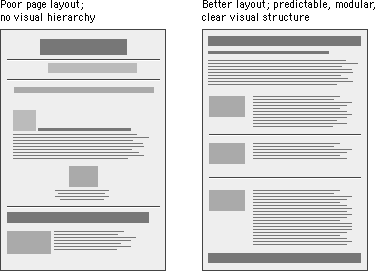
Visual Hierarchy/Page Design: banner integration with layout in a shared blog format (beyond boxes and borders), one solution to the liquid-page banner dilemma (Vision of Darkness)
Child Windows
We will learn how to make a link to a "child window" and close it again. Post the URL of the finished product to the Webx discussion, "child window URLs."
For this exercise, you can use the following picture or a small-to-medium sized one of your own.
Post your exercise to your "exercises" folder and send the URL to the Webx discussion "css1" (from the Discussion link on this page's menu).
Class Blackboard for Thursday 4/19
(Week 14)
Roll
Questions?
For Today...
...open Dreamweaver and import your "www" site information (.ste file).
For Tuesday
We will have a Studio Day on Tuesday to work on your Client Project
Complete and post URLs for all exercises completed by, or assigned at, the end of class today.
Continue work on your Client Project
Bring in materials you've gathered for working on the Client Project
Client Project due by Noon on Wednesday, April 25
Statement Providing Context: When you post your URL to Webx, you should also include in the message an explanation of who your client is, who your client's audience(s) is/are, and other information and commentary necessary to understand your decisions.
Self Commentary: You will turn in your commentary on the project at the beginning of class on Thursday, April 26
Post your exercise to your "exercises" folder and send the URL to the Webx discussion "css1" (from the Discussion link on this page's menu).
Working on Your Project
Class Blackboard for Tuesday 4/24
(Week 15)
Roll
Questions?
Client Project due by Noon on Wednesday, April 25
Statement Providing Context: When you post your URL to Webx, you should also include in the message an explanation of who your client is, who your client's audience(s) is/are, and other information and commentary necessary to understand your decisions.
Self Commentary: You will turn in your commentary on the project at the beginning of class on Thursday, April 26
Wednesday, Thursday and Next Week
By Wednesday by noon, your Client Projects will be due: posted to the Web and the URL of the home page sent in a message to the Webx discussion, "client URLs and analyses."
In addition to the URL, please include in the message an analysis (at least three- or four-sentences long) of your client, which might include:
who your client is
details about your client's non-Web existence and operation
who your site's intended audience(s) are
what actions that you hoped the site would inspire and enable from the audience(s)
what your client wanted from the site
issues or disagreements you had with your client over the site
what ethos and pathos you were trying for in the design of the site
This analysis can be a brief version of your commentary.
On Thursday, we begin the workshop, which will continue on Tuesday and Thursday of next week.
Before class, please do the following:
Review the workshopping page for ideas about what to discuss in your comments.
Visit the Glocalizaiton projects scheduled for the class meeting in the schedule below. Before class on workshop day,
Typeand printout written comments and suggestions for each project scheduled for that day. Bring both the printout of your comments and the digital file to class for copying and pasting (explained below).
copy and pasteall the written comments you've made for everyone scheduled for that day into the form "Workshop Comments for Today" and click "Send to Craig." Be sure to label each set of comments with the project number, the name of the project's author, and the correct date of the workshop.
Write, print, and turn in a commentary on your own project to turn in at the beginning of class.
We will take the projects in the following order on the following days:
Thursday 4/26
1. Angela
2. Daniel
3. Alyssa
4. Pete
5. Gretchen
Tuesday 5/1
6. Kathleen
7. Sarah H. 8. Mark 9. Carly 10. Ron
11. Louis
Thursday 5/3
12. Joel
13. Mathew
14. Justin
15. Judson
16. Landon
Studio Day Today
Class Blackboard for Thursday 4/26
(Week 15)
Roll
Questions?
Collect Commentaries
Next Week's Workshopping
Before class, please do the following:
Review the workshopping page for ideas about what to discuss in your comments.
Visit the projects scheduled for the class meeting in the schedule below, via the links here or in the Webx discussion "client URLs and analyses." Before class on workshop day,
Typeand printout written comments and suggestions for each project scheduled for that day. Bring both the printout of your comments and the digital file to class for copying and pasting (explained below).
copy and pasteall the written comments you've made for everyone scheduled for that day into the form "Workshop Comments for Today" and click "Send to Craig." Be sure to label each set of comments with the project number, the name of the project's author, and the correct date of the workshop.
Write, print, and turn in a commentary on your own project to turn in at the beginning of class.
We will take the projects in the following order on the following days:
My client is my dad and the future business that he wants to create. Until now, he has not had a website. He is an engineer and is always inventing something or coming up with a different, more effective way of doing something else. The intended audience is anyone who is interested in learning about renewable energy sources and how to harness and use that energy in their daily lives. Eventually, it will hopefully serve as a product/information website for his own ideas and inventions, but for now it's mostly just informative. I was going for a simple, yet professional looking design.
Client- Hinks Brothers Construction. New Business so they do not have a web site. The intended audience is for people looking for Hinks Bros. service. I hope this site will inform people about their business and maybe get them some more jobs. My client wanted to be represented in a proffesional manner, and they just wanted to get their name out on the web. I did not counter too many issues with my clients since they are good friends of mine. I wanted this site to be clean and easy to read so people do not get frustrated with the site.
3. Alyssa
Client: Luann Munson, Owner of the Duluth Plato's Closet.
Non-Web Existence: although Plato's closet itself has a website, my client wanted a website just for the Duluth store that people could go to and see what they are currently taking and see what the Duluth store specifically is like.
Intended Audiences: College students that need money or want to be able to shop affordably.
Actions hoped for: I hoped that this website would inspire people to want to come and see what Plato's closet is like. I also wanted it to inspire people to bring in their clothes and shop there.
What client wanted: My client wanted the site to be visually appealing for one. She also wanted it to give a sense of what Plato's closet is like in general, and make people curious and want to come there.
Issues: We pretty much agreed on everything. The only issue that we really had was that I didn't like some of the wording she specifically asked for, and I didn't especially care for some of the backgrounds she chose, but overall we agreed on content.
Ethos Teen Focus Reasonable Prices Name brand clothing New and slightly used Current styles
Pathos Saved Money Fashionable clothing Make money by selling clothes you don’t want anymore Got styles they wouldn’t be able to afford otherwise Feeling more confident about what they are wearing http://www.d.umn.edu/~alfve003/5230/client/PlatosHome.html
my client is Nikki Olson. She hand makes all kinds of aprons to sell from her business from her home. Her intended audience is pretty much everyone, male or female, who likes to wear aprons for whatever. She gave me some content to use and you can see it on the site. Also gave prices for her aprons and styles, too, but no pictures yet. She really made this project hard because she didn't have her act together.
5. Gretchen
Client: Superior Middle School
Web non existence: Actually, the school district just recently put up a brand-new very nice site. I am creating a linked site for incoming sixth graders, that would be accesible through the middle school part of the site. There is nothing up on the district site to welcome new students to the middle school.
Intended audience: incoming sixth graders and their parents
Actions: To answer typical questions new sixth graders have, explain the setup of the school, familiarize self with staff, building, and curriculum
What client wanted: My client (the middle school principal) wanted a site that was easy to navigate but still looked like part of the district website.
Ethos and Pathos: I wanted to appeal to both sixth graders and adults. I did extensive interviewing to see what was needed for the site, and to make the middle school (1100 students) seem like not such a scary place. I also wanted it to look professional and flow well with the original school district website.
Obviously, I still need my client to provide most of the photos and quite a bit of text. I'm working on it.
Web non existence: I suppose she has a myspace, but nothing formal that has her artwork put up.
Intended audience: people who enjoy art and can appreciate the surreal. (Salvador Dali fans will be happy ...) I really, really, REALLY want her to talk to me about her work, where she gets inspiration, but we are both busy people.
Actions: to inspire people to experiment, if not with paints than with ideas in their lives.
What client wanted: My client (the adorable Ashley Grigg) didn't really know what she wanted specifically, other than to have her art published in a way that was accessible. She also didn't want the details altered with photoshop, etc.
Ethos and Pathos: I wanted to appeal to people who like to do art as a hobby, not as criticism. People who can appreciate it and maybe take something with them.
--
I am also trying to find a practical application for this site -- maybe Ashley's advice on how to do some of the techniques she frequently uses. If you have any ideas about what you, fellow classmates, would like to see, please let me know!
7. Sarah H.
Client: Duluth Vineyard Church
Non-Web existence and operation: Church services are held every Saturday and Sunday. This is when people are welcomed into the church, announcements are made, and people have a chance to get to know each other and the pastors at the church.
Intended audience: These members who come to the church and those who want to know more about this particular church.
Actions: To get involved in events at the church, to attend the services, to get to know the pastors or small groups... basically, to get up out of their chairs and GO there.
Client wanted: Service times, information on small groups, ways to contact people, upcoming events.
Disagreements: I felt that it was important to talk about what happens during a typical service so that if someone were to find this site and decide to go to the church, they wouldn't walk into the service and be totally clueless about what was happening. Therefore, I included this information.
Ethos/Pathos: The voice of the text is fairly informal, relaxed, and personal. I wanted the viewer to feel they were in communication with humans, not a machine.
Client: My client is the league secretary of the bowling league. Audience: members of the bowling league, and new perspective teams. Objective: To allow the teams to view there stats before bowling and have a place for new teams to see what the league was like and some links for them to find out new information
My client is the local vintage/retro store, Obscuriosities. I've been in the store before and was really impressed with the array of things they have and the fact that the owners are actually really into their business and the lifestyle it emulates. I made the site as more of a way for people to see what they have and want to visit the store rather than an online web store sort of thing. A typical person to stop in here could be everyone from a movie/music buff to someone simply looking for a T-shirt. I would like people to look at the site and understand that there's more than in the store than is portrayed, and most importantly, that anyone visiting the site would actually want to go shop there, or even just check it out. They pretty much gave me free reign to do what I wanted with the site, but it was still a challenge trying to take a store that's so individualistic and full of items and make a site for it that did it justice, but at the same time was structured and easy to navigate. In order to do this I used some loud colors (the background green, etc), and pictures to show the nature of items they sold.
Craig, my client is Arrowhead Tennis Center(ATC) in Duluth. This site is designed for users to obtain information about ATC in regard to tennis lessons, memberships, court hours, and other areas of the Arrowhead Tennis Center & Athletic Club complex. Keep in mind that Arrowhead Tennis Center is a division of the Arrowhead Tennis Center & Athletic Club here in Duluth. Also, the reason why I have a 'Wilson' sports logo on my Web site is because I consulted with Tracy Broin, the director of ATC and she said that it is imperative that I list their sponsor on this site. Wilson equipment is stocked and sold at ATC under a contract and therefore, this is the reason why it is listed on my Web site. At the request of my client, I have included a privacy statement and a synopsis about the faciliity at the bottom links of the pages.
This is a cafe/bar/restaurant. Their services include delivery and other things. Options that still need to be added are employee's favorite meals. So that when a customer finds that they have similar tastes of the employee, they can then know what food to try next. Also this restaurant delivers all food but breakfast. A map describing their delivery zone would be quite helpful. With a business that provides so many services there will be continual improvement of this site, also with the increased usage of the site by people the purpose will be continually changing. Also this page was meant to be more dynamic than professional. A typical customer visiting this site will likely be a “bar fly.” They are not concerned if the site looks nice, they want the site to be fun, and look and feel like the business does when you are actually there.
- Brett Groehler (University Photographer) in this case Brett Groehler Photography (seperate from UMD)
Brett shoots freelances on the side, ussually in the summer- mostly weddings and some sports.
The audience is engaged couples planning a wedding in the DUluth area. The desired action from them is an inquiry about having their wedding shot or a link to buy prints to Print Room if they are a previous customer
I didn't really have any disagreements about the site, I was given pretty free reign outside of the content desired.
The ethos and pathos would focus on quality work and catching the emotion of a wedding.
Non-Web Existence: My client does a lot of freelance work and also is employed by late night kirby, he does a lot of the posters we see hanging around school, like the ones on the homepage of my site. Before this website was created, he had no way of people finding him other then by word of mouth, now anyone in the world can use his services.
Intended Audience: Anyone business or individual who is in need of brand identity, a poster for an event, a logo for a t-shirt, pretty much anything involving images.
Actions from Audience: I want the audience to feel that after they have visited this site that they have seen what Mike is capable of creating and are comfortable with him creating something for them.
Client Wants: He simply left it to me and supplied me with some images. I came up with the concept and layout and all the content minus his images.
Ethos and Pathos: I wanted to create simplicity and ease on the eyes. I don't want people to be confused when looking at this site, not much work in navigating the site and everything is nice and straight forward.
Class Blackboard for Tuesday 5/1
(Week 16)
Roll
Questions?
Thursday's Workshopping (Last Day of Class)
Before class, please do the following:
Review the workshopping page for ideas about what to discuss in your comments.
Visit the projects scheduled for the class meeting in the schedule below, via the links here or in the Webx discussion "client URLs and analyses." Before class on workshop day,
Typeand printout written comments and suggestions for each project scheduled for that day. Bring both the printout of your comments and the digital file to class for copying and pasting (explained below).
copy and pasteall the written comments you've made for everyone scheduled for that day into the form "Workshop Comments for Today" and click "Send to Craig." Be sure to label each set of comments with the project number, the name of the project's author, and the correct date of the workshop.
Write, print, and turn in a commentary on your own project to turn in at the beginning of class.
My client is my dad and the future business that he wants to create. Until now, he has not had a website. He is an engineer and is always inventing something or coming up with a different, more effective way of doing something else. The intended audience is anyone who is interested in learning about renewable energy sources and how to harness and use that energy in their daily lives. Eventually, it will hopefully serve as a product/information website for his own ideas and inventions, but for now it's mostly just informative. I was going for a simple, yet professional looking design.
Client- Hinks Brothers Construction. New Business so they do not have a web site. The intended audience is for people looking for Hinks Bros. service. I hope this site will inform people about their business and maybe get them some more jobs. My client wanted to be represented in a proffesional manner, and they just wanted to get their name out on the web. I did not counter too many issues with my clients since they are good friends of mine. I wanted this site to be clean and easy to read so people do not get frustrated with the site.
3. Alyssa
Client: Luann Munson, Owner of the Duluth Plato's Closet.
Non-Web Existence: although Plato's closet itself has a website, my client wanted a website just for the Duluth store that people could go to and see what they are currently taking and see what the Duluth store specifically is like.
Intended Audiences: College students that need money or want to be able to shop affordably.
Actions hoped for: I hoped that this website would inspire people to want to come and see what Plato's closet is like. I also wanted it to inspire people to bring in their clothes and shop there.
What client wanted: My client wanted the site to be visually appealing for one. She also wanted it to give a sense of what Plato's closet is like in general, and make people curious and want to come there.
Issues: We pretty much agreed on everything. The only issue that we really had was that I didn't like some of the wording she specifically asked for, and I didn't especially care for some of the backgrounds she chose, but overall we agreed on content.
Ethos Teen Focus Reasonable Prices Name brand clothing New and slightly used Current styles
Pathos Saved Money Fashionable clothing Make money by selling clothes you don’t want anymore Got styles they wouldn’t be able to afford otherwise Feeling more confident about what they are wearing http://www.d.umn.edu/~alfve003/5230/client/PlatosHome.html
my client is Nikki Olson. She hand makes all kinds of aprons to sell from her business from her home. Her intended audience is pretty much everyone, male or female, who likes to wear aprons for whatever. She gave me some content to use and you can see it on the site. Also gave prices for her aprons and styles, too, but no pictures yet. She really made this project hard because she didn't have her act together.
5. Gretchen
Client: Superior Middle School
Web non existence: Actually, the school district just recently put up a brand-new very nice site. I am creating a linked site for incoming sixth graders, that would be accesible through the middle school part of the site. There is nothing up on the district site to welcome new students to the middle school.
Intended audience: incoming sixth graders and their parents
Actions: To answer typical questions new sixth graders have, explain the setup of the school, familiarize self with staff, building, and curriculum
What client wanted: My client (the middle school principal) wanted a site that was easy to navigate but still looked like part of the district website.
Ethos and Pathos: I wanted to appeal to both sixth graders and adults. I did extensive interviewing to see what was needed for the site, and to make the middle school (1100 students) seem like not such a scary place. I also wanted it to look professional and flow well with the original school district website.
Obviously, I still need my client to provide most of the photos and quite a bit of text. I'm working on it.
Web non existence: I suppose she has a myspace, but nothing formal that has her artwork put up.
Intended audience: people who enjoy art and can appreciate the surreal. (Salvador Dali fans will be happy ...) I really, really, REALLY want her to talk to me about her work, where she gets inspiration, but we are both busy people.
Actions: to inspire people to experiment, if not with paints than with ideas in their lives.
What client wanted: My client (the adorable Ashley Grigg) didn't really know what she wanted specifically, other than to have her art published in a way that was accessible. She also didn't want the details altered with photoshop, etc.
Ethos and Pathos: I wanted to appeal to people who like to do art as a hobby, not as criticism. People who can appreciate it and maybe take something with them.
--
I am also trying to find a practical application for this site -- maybe Ashley's advice on how to do some of the techniques she frequently uses. If you have any ideas about what you, fellow classmates, would like to see, please let me know!
7. Sarah H.
Client: Duluth Vineyard Church
Non-Web existence and operation: Church services are held every Saturday and Sunday. This is when people are welcomed into the church, announcements are made, and people have a chance to get to know each other and the pastors at the church.
Intended audience: These members who come to the church and those who want to know more about this particular church.
Actions: To get involved in events at the church, to attend the services, to get to know the pastors or small groups... basically, to get up out of their chairs and GO there.
Client wanted: Service times, information on small groups, ways to contact people, upcoming events.
Disagreements: I felt that it was important to talk about what happens during a typical service so that if someone were to find this site and decide to go to the church, they wouldn't walk into the service and be totally clueless about what was happening. Therefore, I included this information.
Ethos/Pathos: The voice of the text is fairly informal, relaxed, and personal. I wanted the viewer to feel they were in communication with humans, not a machine.
Client: My client is the league secretary of the bowling league. Audience: members of the bowling league, and new perspective teams. Objective: To allow the teams to view there stats before bowling and have a place for new teams to see what the league was like and some links for them to find out new information
My client is the local vintage/retro store, Obscuriosities. I've been in the store before and was really impressed with the array of things they have and the fact that the owners are actually really into their business and the lifestyle it emulates. I made the site as more of a way for people to see what they have and want to visit the store rather than an online web store sort of thing. A typical person to stop in here could be everyone from a movie/music buff to someone simply looking for a T-shirt. I would like people to look at the site and understand that there's more than in the store than is portrayed, and most importantly, that anyone visiting the site would actually want to go shop there, or even just check it out. They pretty much gave me free reign to do what I wanted with the site, but it was still a challenge trying to take a store that's so individualistic and full of items and make a site for it that did it justice, but at the same time was structured and easy to navigate. In order to do this I used some loud colors (the background green, etc), and pictures to show the nature of items they sold.
Craig, my client is Arrowhead Tennis Center(ATC) in Duluth. This site is designed for users to obtain information about ATC in regard to tennis lessons, memberships, court hours, and other areas of the Arrowhead Tennis Center & Athletic Club complex. Keep in mind that Arrowhead Tennis Center is a division of the Arrowhead Tennis Center & Athletic Club here in Duluth. Also, the reason why I have a 'Wilson' sports logo on my Web site is because I consulted with Tracy Broin, the director of ATC and she said that it is imperative that I list their sponsor on this site. Wilson equipment is stocked and sold at ATC under a contract and therefore, this is the reason why it is listed on my Web site. At the request of my client, I have included a privacy statement and a synopsis about the faciliity at the bottom links of the pages.
This is a cafe/bar/restaurant. Their services include delivery and other things. Options that still need to be added are employee's favorite meals. So that when a customer finds that they have similar tastes of the employee, they can then know what food to try next. Also this restaurant delivers all food but breakfast. A map describing their delivery zone would be quite helpful. With a business that provides so many services there will be continual improvement of this site, also with the increased usage of the site by people the purpose will be continually changing. Also this page was meant to be more dynamic than professional. A typical customer visiting this site will likely be a “bar fly.” They are not concerned if the site looks nice, they want the site to be fun, and look and feel like the business does when you are actually there.
- Brett Groehler (University Photographer) in this case Brett Groehler Photography (seperate from UMD)
Brett shoots freelances on the side, ussually in the summer- mostly weddings and some sports.
The audience is engaged couples planning a wedding in the DUluth area. The desired action from them is an inquiry about having their wedding shot or a link to buy prints to Print Room if they are a previous customer
I didn't really have any disagreements about the site, I was given pretty free reign outside of the content desired.
The ethos and pathos would focus on quality work and catching the emotion of a wedding.
Non-Web Existence: My client does a lot of freelance work and also is employed by late night kirby, he does a lot of the posters we see hanging around school, like the ones on the homepage of my site. Before this website was created, he had no way of people finding him other then by word of mouth, now anyone in the world can use his services.
Intended Audience: Anyone business or individual who is in need of brand identity, a poster for an event, a logo for a t-shirt, pretty much anything involving images.
Actions from Audience: I want the audience to feel that after they have visited this site that they have seen what Mike is capable of creating and are comfortable with him creating something for them.
Client Wants: He simply left it to me and supplied me with some images. I came up with the concept and layout and all the content minus his images.
Ethos and Pathos: I wanted to create simplicity and ease on the eyes. I don't want people to be confused when looking at this site, not much work in navigating the site and everything is nice and straight forward.




















 First Day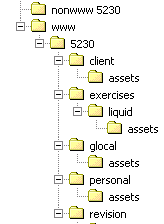



 For this exercise, you'll need to visit the