|
From PBS:
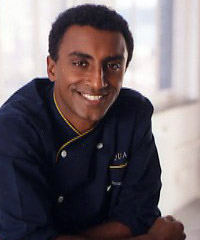
Marcus Samuelsson, host
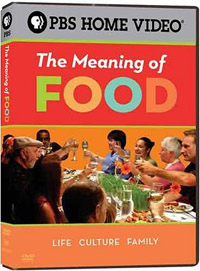
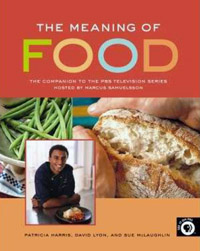
The Meaning of Food
(ca. 180 min., CC, 2007, UM Duluth Martin Library Multimedia GT2853.U5 M43 2005 DVD)
Description
"'Tell me what you eat and I'll tell you who you are.'
-- Anthelme Brillat-Savarin"
"Every living thing needs food to survive, but for humans, food has a much deeper and more complex significance. This beautifully illustrated, thought-provoking book explores the role of food in our lives, going on location to thirteen ethnic communities across the United States and examining, through stories, pictures, and interviews with food experts, the many ways that food is an expression of our humanity. It parallels a three-part PBS series hosted by acclaimed New York chef Marcus Samuelsson."
"From an Italian-American wedding in San Diego to a Mexican-American family's Christmastime tradition of making holiday tamales, The Meaning of Food delves into the ways that food binds us to family and culture. It looks in on a Jamai Shasthi ceremony, in which foods promoting fertility are fed to the sons-in-law of a Bengali family in California. It accompanies a woman to South Carolina's coastal lowlands as she explores her Geechee heritage, making red rice with a culinary historian. It enters the kitchen of an East Texas Czech family as they prepare for this year's kolache bake-off. It explains the anthropological signficance behind these and other vignettes, revealing the importance of culinary tradition and celebrating our cultural diversity as expressed through food."
"The Meaning of Food speaks for the revival of the kitchen and the table as centers of pleasure, culture, and community. With 15 recipes, including several developed by Marcus Samuelsson specifically for the series, and more than one hundred color photos, many of them captured from the series footage, it will be a wonderful addition to the library of anyone interested in food and culture."
"'There is communion of much more than our bodies when bread is broken and wine is drunk' --M.F.K. Fisher"
"No matter who we are or where we live, our lives revolve around food. Much more than simple sustenance, food is part of our culture and our traditions. Everything about eating — including what we eat, how it tastes, who prepares it, and who's at the table — is a form of communication rich with meaning."
"This beautifully illustrated, thought-provoking book explores the role of food in our lives. Paralleling a three-part PBS series hosted by acclaimed New York chef Marcus Samuelsson, The Meaning of Food goes on location to twenty ethnic communities across the United States and examines, through stories, pictures, and interviews, the many ways that food is an expression of our humanity. It shows how our attitudes, practices, and rituals around food reflect our most basic beliefs about our world and ourselves. Included in this book are the recipes from the television series and 200 color photographs, many of them captured from the series footage."
"From an Italian-American wedding in San Diego, to a Mexican-American family's Christmastime tradition of making tamales, to a South Carolina woman's exploration of her Geechee heritage, The Meaning of Food sheds light on who we are as Americans."
"'We do not sit at the table only to eat, but to eat together."
-- Plutarch"
Episode 1: "Food & Life"
examines the symbolic importance of food and eating
Nothing says lovin’ like something from the oven.”
— 1960s Pillsbury advertising slogan
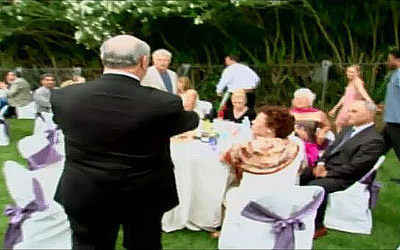
As host Marcus Samuelsson says, “Food is powerfully symbolic and really complex. Through food we express love. We bring comfort and hope. We forge new relationships and strengthen old bonds. Food reaffirms not only our humanity but the joy of being alive. ”In “Food and Life,” we travel across America and meet people with a powerful connection to food. Included in the episode are Mike Piancone, the owner of an Italian gourmet shop in Southern California who expresses his love for his daughter by preparing an elaborate Italian banquet for her wedding; Mita Guha, a Bengali woman in Orange, California who cooks a “Jamai Shasthi” — a traditional Indian fertility feast — for her sons-in-law; and Richard Zhiri, whose Chicago lunchcart delivers a welcome taste of home to African immigrant cabdrivers. We go behind the scenes with some customs agents from JFK Airport, who show us the unusual foods people try to bring back from their homelands, and meet Brian Price, a former Texas convict who prepared final meals for those about to be executed. Also included are Shatreen Masshour, a Muslim-American cheerleader who struggles to maintain her first Ramadan fast; Bianca Steiner Brown, a Holocaust survivor who recalls the awesome power that memories of food had for women in the Nazi concentration camp at Terezin; and Thomas Soukakis, a Seattle-based Greek immigrant who has suffered tragic loss but finds a reawakening of joy and hope by opening a restaurant named Vios, the Greek word for “life.” As we learn from the stories in “Food and Life,” food means so much more than simple nourishment. As writer MFK Fisher said, “It seems to me there are three basic needs; for food, security and love are so mixed and mingled and entwined that we cannot straightly think of one without the other. There is a communion of more than our bodies when bread is broken and wine is drunk.”
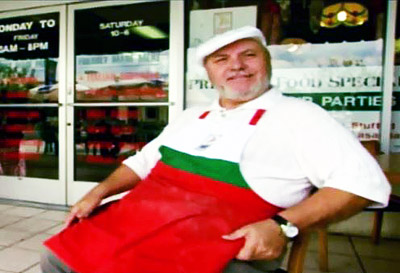
Mike Piancone
|
- Mother's Milk & the Foods of Home
|
|
Episode 2: "Food & Culture"
explores how food delineates the different cultures that make up the American 'Melting pot'"
Award-winning chef and MEANING OF FOOD host Marcus Samuelsson knows more about the complex stew of food and culture than many. Born in Ethiopia, Marcus was adopted and raised in Sweden and, as he says, “Everywhere I’ve been, everything I am is reflected in my feelings about food. America is called a melting pot, but I think it’s more like a stew where individual flavors are still present yet create a whole. Like me, many of us have mixed backgrounds and influences. We struggle between holding on to our cultural heritage and fitting in, and nowhere is this more clearly expressed than through food.” Our “Food and Culture” episode explores how what we eat connects us with who we are through a variety of stories that unfold across America. The episode begins in South Carolina where filmmaker Julie Dash, writer/NPR commentator Vertamae Grosvenor, and poet Nikki Finney cook rice and share memories about their unique Geechee heritage. We explore how one culture’s delicacy can be another’s ultimate gross-out as we learn about an unusual fruit called the durian, which is a truly acquired taste. We then visit a reservation in Neah Bay, Washington, where the Makah Indians are returning to their ancient tradition of hunting and eating whale, to the displeasure of some non-Makah; hear Hawaiians celebrate kalo and poi; and, finally, visit with a large Czech community in south-central Texas where the art of making the kolache, a danish-like pastry, is still being handed down through the generations. In an America lined coast-to-coast with fast-food and generic chain restaurants, holding on to the foods that make us unique and remind us of where we came from can be a challenge. But as we see in this episode, food is perhaps the thing a culture clings to with the greatest passion, against the tide of mainstream America.
Episode 3: "Food & Family"
looks at the complex way food defines families
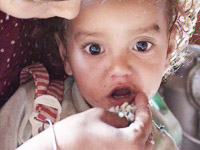
Food is a tie that binds us to our families in powerful and pervasive ways. From our first sip of mother’s milk to a post-funeral potluck buffet, our lives are bracketed by and defined by food. Shopping for food, preparing it, eating it — through these small, daily rituals, bonds are forged and memories are created.In “Food and Family,” we meet several families whose relationship with food is central. We visit a 24-hour diner in Chicago where people come together in a sometimes decades-long ritual of communing and consuming. Through Hsiao-Ching Chou, the award-winning food writer for the Seattle Post-Intelligencer, we explore the complex tangle of love and duty experienced by many of the families that run the more than 25,000 Chinese restaurants nationwide. Hsiao-Ching takes us back home to the family restaurant in Missouri and shares bittersweet memories of seven-day work weeks — as well as her family’s prized recipe for dumplings. We learn about the elaborate art of “obento” — the creation of exquisite, jewel-like lunch box treats that some Japanese-American mothers still practice; visit with the Cruz family of San Benito, Texas as they celebrate the Christmas holidays with a tamale-making marathon called a “tamalada;” and go to St. Paul, Minnesota for a peek into the local male-bonding ritual called a “booya,” the creation of a huge stew that’s made from a recipe passed from father to son, takes all night, and requires lots of beer in both the pot and the chefs. Our episode ends with the funeral of Vaai Fano, a Samoan woman who is honored by her huge extended family with a traditional week-long gathering done 'fa’a Samoa’ — in the Samoan way — that includes the feeding of hundreds of friends and relations.
- (1159 South Canal St., Chicago, IL)
- (Missouri)
(cf., China > Food)
- (cf.,Anne Allison, "Japanese Mothers and Obentō: The Lunch-Box as Ideological State Apparatus." Anthropological Quarterly 64, 4: 195-208, [October 1991])
- (San Benito, Texas)
- ("male bonding ritual" in St. Paul, MN)
class Booyah WebPage
|
|